Seared Russian Children
Not too much happening in Beijing. A lot of people are on vacation and so I have just been hanging out in the good old jing. My buddy Matt gets here this week and I go on vacation in a couple weeks, so its all looking good. This past weekend I went to a Russian restaurant in the Russian district of Beijing. I ordered some crazy Russian food, the appetizer was pretty good, and when my main dish of chicken showed up, I dug in. About three bites in, I feel something hard in my mouth, luckily I did not bite hard enough to chip a tooth. A tooth you say! When I got the hard particle out, it looked like a very small tooth or chite pebble. I kept eating the dish because, well, regardless of its origin, it tasted good. After lunch I took a closer look, and both Jason and I are pretty sure it was some sort of baby tooth. Babies sure are yummy. So the much-hyped myth of Soviet communists eating their young to work in their socialistic utopia was true. Who knew McCarthy was so clever. If you like babies, send me an email and I well tell you a good restaurant to have some seared baby meat with mushroom sauce.
Part IV – Kung Fu (comical)
Prior to this weekend, I had not left Beijing for vacation in over a month. I was starting to go crazy and consequently, determined to leave the city for the weekend. I originally wanted to go to a Beach resort, but that proved next to impossible due to the number of people traveling. We finally settled on Luoyang, an unimposing town in Henan province, which was the capital city for most of the Chinese dynasties until 1000 AD. I went down there with my buddy Jason, who is from BC. On a side note, this will be my first non-serious article in a while, so bear with.
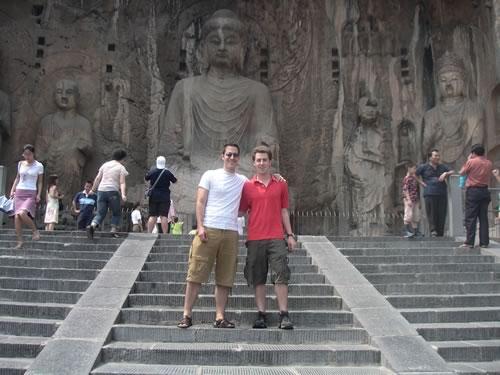
Friday evening, we purchased a dozen beers at the local corner store for about 20 RMB (2$) and took off to the train station by subway, on which we drank most of the beer, and thus had to purchase more. Arriving at the train station with an exorbitant 10 minutes to spare, we made it onto the train and to our beds. We had to purchase the tickets off scalpers due to the amount of people in this country and the lack of trains. After arriving, we promptly over paid for a hotel and got some food. We then made our way to Longmen, which is a UNESCO world heritage site, about 13 km from Luoyang. The site is home to over 100 000 Buddha carvings in grottoes and caves, the largest of which is 17 m short. Really, an extremely impressive site, especially considering the lack of Chinese tourists being, well, Chinese tourists. According to the posted information, “Westerners”, during the 19th century and early 20th, decapitated many of the statues. While this is true, a good deal of the statues were destroyed during the cultural revolution, but, curiously, this is mentioned nowhere at the site; only that foreign people took the statues away from their homeland. One of the larger frescos is on display at the MET, in NYC. Nevertheless, a remarkable site.
At the site you can hire electric golf cart vehicles to take you back to the parking lot as the site is quite large. We decided that the price of 8 RMB (1$) was out of our budget, so we stole a car. I wish I could have taken a picture as the Chinese women screamed Ai Yo Ai Yo Ai Yo ( I do not think I need to translate that) and running after us. After realizing that some of them may be summarily executed for losing a vehicle worth more than their entire extended family, to their great relief, we returned it. Eventually we found ourselves at the main bar street in Luoyang.
No matter where you are, you can usually manage to find some form of a party on a Saturday night. But, of course, not in Luoyang. After visiting every bar in the area, we settled on one with a half decent band. We ordered a bottle of Vodka, but afterwards, realized that the bar did not sell Red Bull. We then had to argue for 30 minutes to get our money back for the unopened bottle. This typical Chinese behavior of arguing over everything and certainly not putting the customer first is prominent and I have many stories pertaining to this. We then switched bars to one with few customers, but a cute barmaid. Pretty bored, we decided to get 2-hour, legitimate, massages, which, actually were pretty damn good.
The next day we visited the first Buddhist temple in China, the White Horse temple. The barmaid from the previous night was our tour guide pro bono, and the temple was actually very nice, one of my favorites so far. That night, after a traditional Luoyang Water Banquet, we ended up back at the same bar. A water banquet is dinner with only various types of soup; it was actually pretty good. Only that night at the bar, there were some people! We were quietly sipping on our 2$ coronas when some Chinese guys thought they would make a night of it and break bottles over each other’s heads. Now we are at the part of the story related to the title of such said story. Modern Chinese men leave something to be desired. Perhaps that is a little to general, but speaking from numerous testimonies and what I have seen I have less and less doubt as to the veracity of the previous statement. In the west, if you really have a problem with someone you will solve it with a good old fashion fistfight. In China, the land of Kung-Fu, people do not respectfully bow, take a stance and then beautifully fight until the opponent’s White Palm style is proven inferior to the victor’s Shaolin Wushu style. After the initial move is made, they both run for the bar and grab bottles, and attempt to play mole-in-the-hole with each other. The rapidity for which they go for weapons is really appalling; anyone doing such in a western country would run a high risk of jail time. Because, simply put, you can really fuck someone up with a broken bottle. So bottles are broken, ash trays are flying, and people are fleeing. There is blood all over the place, one guy is obviously drunk and just wants to keep going despite the 3L of his blood that now grace the floor, his friends shirts, and the benches. After the bar counter is cleared of potential projectiles his friends manage to get him out of the bar and into a taxi; mind you, not easily. Speaking of which, god knows what taxi would be willing to take 3 people covered in blood and one person bleeding very rapidly for a ride home. Now what’s even more remarkable is that after this fight we go back into the bar and order some more drinks; mind you, that is not what is remarkable. It’s that there were no bouncers, hence no one to stop the fight, god knows Jason and I were not going to step in to stop 5 stupid Chinese guys from killing each other, because we both have a desire to live past 27 and 22 years respectfully. Also, no cops ever showed up to take testimony or make sure no bodies were being cut up and buried in the basement. Talk about a great police state. After the other half of the fight left the bar, the barmaids breath a sigh of relief and explain how the fight actually started. Supposedly one guy bumped the other and the other did not apologize. Can you say Pai Mei and the massacre of the Shaolin temple?
So everything gets back to normal and we start playing Jenga. Ridiculous, yes, I know, but just wait. Then, we start chatting up a couple girls and when everything seems to be going well, this guy that had been “hanging” out with Jason decided it is wise to come and try and dance with me. This guy could not be any more drunk, or gay; and not gay in a bad kind of way, just gay. I have nothing against homosexuals, but this one was insisting on buying us drinks, grabbing our limbs and dancing with us. Enough said, the two girls take off. I promptly tell Jason that I am out of there and I try to grab some drinks that I had bought for the chicks, but were never touched. This guy grabs the drinks out of my hands and pours them down his throat, well, at least half down his throat and half on his face. I run out of the bar. I wait for Jason to extricate himself and we literally run away from the bar, this guy, his friends, the blood and the chaos; we then jump into a moving taxi.
Lets just say the night did not end there, but this entry is long, and I will leave the rest of the story for face-to-face encounters.
The last day of our trip, which was extended due to our inability to purchase train tickets, was spent at the Shaolin temple and some other surrounding ones. The temples were really nice, but like most temples, too much alike. The temples in China have a tendency to be rebuilt and be identical to all other temples. The actual Shaolin complex is huge and I had been for-warned of its touristy nature. The new buildings dwarf the old temple, but that is the cost of modernization. Nevertheless, it was very interesting. We saw some Shaolin Kong-Fu kids (up to 15 years old) do some pretty impressive things. One kid, at one point, looked more like a wal
king pretzel than he did a human. We checked out the famous stupas and took in the atmosphere. We Challenged the Shaolin monks to various feats of strength and I think they were convinced our Jianada Kong Long Kong Fu was vastly superior (translation: Canadian Dinosaur Kung Fu).
We got back to the city, picked up some scalped tickets, a case of beer and got on the train. I am back in Beijing, tired, but very happy to have seen some Chinese culture.
In the words of the great chairman Mao Zedong, “Hao Hao Xue Xi Tien Tien Xiang Sheng” or Good Good Study Day Day Rise Up, which means, “Study well everyday and you will rise to the top”
Part III – Higher Education
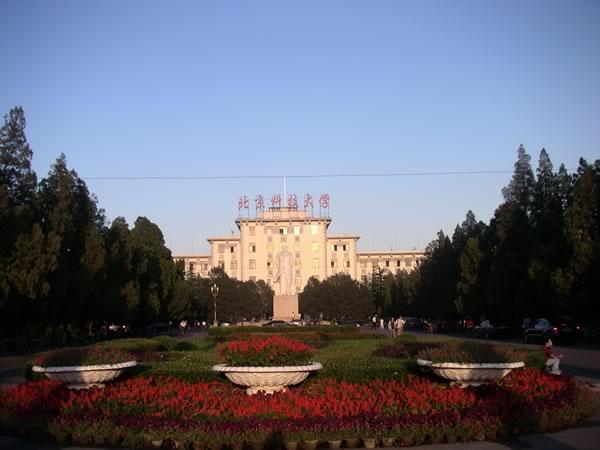
I have been up at the Beijing Science and Technology University for the past week meeting with students and professors to look at their work. As pretty much all of the reports are in Chinese it is rather difficult to review most of their work. The atmosphere on campus is not un-similar to that back home, but it is definitely more “high-schooly” with breaks for lunches, huge cafeterias and much less recreation – though there are a slew of basketball courts.
The most particular thing that hit me is the different attitude that students have compared to the older Chinese people. And, by older, I mean 8-15 years their elder. They are much more western, are more confident and do not stare at white people nearly as much. I suppose all of these things are good things, but there is still a much more hesitant and rigid behavior pattern compared to a western campus.
On my first day, at about 5:30, A recording started blaring from the loud speakers all over campus. When I asked what was being said, I was told that it was Hu Jintao speaking about the 60th anniversary of Chinese victory over Japanese Imperialism. For the past little while, the Chinese television channels have been dominated by fiction, non-fiction, and partly factual shows about China under Japanese rule. The most curious thing is that they strongly maintain that China was the largest contributor to the defeat of Japan and that glorious China had a little bit of help from the west, but not that much. Which, is of course, quite ridiculous. So, as this is too much nonsense to handle, a friend and I decided to go trolling. Trolling entails going on websites and blogs to work people up by posting comments to their articles. One such patriotic Chinese citizen writes articles at the China Daily (the Chinese Governments English Language Paper), we would post various comments under various pseudo-names and to say the least, it got them quite worked up.
The article and comments can be found here: http://www.chinadaily.com.cn/english/doc/2005-09/01/content_474286.htm
The point of this is that Chinese people have a real difficult time dealing with foreign criticism of their various practices and policies. I mentioned this in an earlier post but would like to develop more on the idea.
Obviously nationalism makes people put up a barrier against any foreign criticism being deemed legitimate, but in the end I believe that logical discussion can make someone change their mind. In a previous post, I had sent an email to a Chinese friend and she had replied saying that we had no right to criticize China, but after a further reply by a friend, she has agreed that she was wrong. I even sometimes find it difficult to let critcism of something I know is bad go unchecked when the subject is close to me. For example, when someone criticizes Israel, I often feel compelled to defend its various policies despite the fact that I know those policies are wrong. The point is that on many subjects I can argue both sides with a significant amount of knowledge and while I try to distance myself from emotional attachment to a subject that would interfere with rational discussion, sometimes I cannot help it. I know I am really brushing over this topic quickly, but it is just to say that there is still a large amount of rigidity in public opinion and behavior in China that will definitely impede social progress and the improvement of the Chinese society. A society that is most creative and innovative must be fundamentally open and if social thought restrictions are imposed, then they will inevitably lead to less a less creative and efficient population.
When those loud speakers start up everyday, they remind me that yes, this is still a state controlled society. Not so long ago, those very same speakers where inciting students to bang pots to disturb the birds and to destroy all things of historic China. Namely, it was over those lour speakers that the Cultural Revolution began. Until the masses realize the truth behind the mirage that is presented by the government, this country will never become the “Great Chinese Superpower” that is heralded as inevitable in all the western countries. In fact, this year, a newspaper journalist from Hong Kong was whisked away to jail when he revealed that he had been informed that his paper should not mark or mention the fifteen-year anniversary of the Tiananmen Massacre. At the entrance of the universities there is a large Mao Statue and I am really curious when they will be pulled down by angry mobs just as Lenin, Stalin, and the other dictators of the world have been.
On a lighter note, my buddy Matthew Finn is arriving tomorrow. He is flying with Air Canada and already, 10 hours before departure, his flight had been delayed 4 hours! You know, it is really hard to see why Air Canada does not do well. I think Robert Milton (Air Canada CEO) should be nominated for best CEO ever. Matt and I are off to south china next week for a couple weeks of traveling and sightseeing. We were going to go to Tibet but I have spent all my money on bars and woman and can’t afford to go anymore. Oh well, South China next week and Burma in December, not too bad. Tibet has too many tourists anyways. Will definitely go to Bhutan soon, the most intact ancient culture remaining in the world, but that is really expensive.
Part II – Red, White and Blue, minus the White and Blue

Red, White and Blue are usually associated with the USA, but those three colors also find themselves on the British and French flags and together, the three countries are at the origin of the international language, the capitalist free-market system, freedom of press, modern day entertainment, industrialization, democracy, and so on. While they are not right in many of the things they do and have a long history of mistakes and exploitation, they are the undeniable source of the way the world is shaped today. Yet, China is the oldest country in the world, with a rich history dating back to 1000 BC and we are seeing a renewal of Chinese heritage. They invented most things before the west and up until the mid 15th century, were the most powerful nation in the world. That being said, today, nearly everything new is from the west. That is not to say that there is no modern Chinese culture, there is. Art Galleries are more prominent in Beijing than in most cities in the world, modern Chinese literature is abundant and many ‘new’ Chinese appreciate traditional Chinese practices with a modern twist.
To me, what remains most disconcerting about modern China is their inability to learn from the mistakes of others, namely the west. In the first half of 2005, two thousand seven hundred miners have died in China (and that number is most likely, much higher), rapid degradation of the environment is found around the country, serious outbreaks of disease are occurring more and more frequently and 16 Chinese cities are found on the list of the 20 most polluted cities in the world. Sound doomy and gloomy? Well, in a way, it is. Does China have the will, resources and power to change the situation? Undeniably. The main impediment to any motion regarding these issues is a lack of information and education, unlike in the West, it still remains difficult to obtain clear and un-contorted reports on such issues. These examples are not the basis of the article, but simply illustrations of New China’s disregard for the mistakes that come hand in hand with industrialization and modernization of a society.
People do not seem to value human life here as much as back home, which is not surprising considering there are 1.35 billion people in this country. In China, there are 30 000 deaths per year due to car accidents (and this is rapidly rising). In Australia, where there are approximately the same number of cars, there are 3 000 deaths. Anyone who has traveled in China will know that the problem lies in the huge discrepancy of the quality of trucks and vehicles and the lack of strict guidelines regarding what can go on the road (or at least, their enforcement). China seems to be adopting many of the Western policies that benefit them best and leaving the troublesome ones like environmental regulations, human rights and transparency behind.
I will try to get back on course and address the state of western culture in China, which was the original purpose of this piece. On the surface, and what I first thought, was that the same generic rap is blasted at clubs, the young dress the same as their western counterparts, behave the same, eat at the same fast food restaurants, aimlessly peruse shopping malls, and drink the same carbonated beverages. While this is definitely true of part of the new wealthy class is China it overlooks the vast majority of society which can only dream of such privileges. But, even in the lower classes, there is more and more westernization; they drink more beer and less tea, watch American movies, and wear Nike t-shirts. Is this a bad thing? Rather, as with most of the world it seems inevitable. From Cairo to Bangkok to Johanesburg, Americanization is rampant and growing. The question becomes what remains of essence to a culture? And, therefore, requires protecting. While there is no risk of the Chinese language going the way of the dodo, it is curious to see that most ABCs (American Born Chinese) or CBCs do not speak Chinese. I commonly meet North American Chinese who are here to learn Chinese, which is demonstrative of the renewed pride in their heritage and recognition of the importance of knowing Chinese. In terms of protecting culture, the most evident example to me are the language laws in Québec. (For those unaware, there are strict laws in the Canadian province of Québec dictating that all signs must be in French and that children must attend French school.) These laws, to many, seem excessive, but it is clear that they have prevented the French language from being wiped out of North America and have undoubtly contributed to the rich culture found in the urban centres of Montréal and Québec City. Take for comparison the amount of French currently spoken in New Orleans. In terms of Americanization, clothing is usually the first thing to go, then perhaps an encroachment on diet, and next we see a standardization of mass media. So, to preserve and promote the history, traditions, and culture of a country like China is of growing importance. But, Chinese people have a very peculiar perception of what historical conservation and preservation is.
Chinese value the appearance of the object rather than its authenticity, and I am not talking about the fake Rolexes, lacoste shirts and puma shoes. Historical monuments are commonly rebuilt and while they are usually accurate reproductions, they are no longer historic, simply historic looking. The Badaling section of the Great Wall of China (the closest part to Beijing) has been completely rebuilt and it seems quite fair to consider it a modern construction that bears no authenticity to the original wall except location. I have traveled through cities that are being built from scratch to look like an old Chinese city to attract tourism and compliment an authentic historical site that may be found near by. Fake antiques are so common that it is becoming increasingly rare to find anything ‘real’ and dealers usually pass of ‘old-looking’ as simply old to the unwitting tourist. When most of your monuments and antiques were destroyed (90% during the cultural revolution), it seems natural to rebuild them and to honor them as though they were authentic. Yet, in many cases where the item was not completely destroyed, there is a very fine line between restoration and reconstruction. I highly recommend an article by Ron Gluckman about fakes in China (http://www.gluckman.com/ChinaFraud.html). (Look at his other articles as he has some really great ones about China.)
I have seen a good deal of high quality modern artwork in Beijing. Chinese painters are becoming more and more famous on the international stage and the works are starting to go for similar prices to their western counterparts. I have posted some photos from a recent sculpture exhibition, which featured the work of China’s best modern artists. There are numerous enclaves of studios and galleries in and around Beijing where modern art is flourishing. Namely, an old factory district called simply 798 that has been converter into galleries and studios is the hippest place in town and anyone who is anyone is living up there. What seems to plague a lot of the work is a recurrent theme of political protest by mocking communist posters, figures, and slogans. From what I have seen, and apart from photographs, most art is anti-party rather than anti-poverty or anti-exploitation. But, obviously this is my personal opinion and probably incorrect. This resurgence of Chinese artists is concurrent with the country’s growing wealth and the populations Americanization.
Americanization is synonymous with conspicuous consumption. The rapid development of China has meant that advertisement regulations are non-existent. The subway is plastered with ads, people are handing out millions of flyers,
cigarettes are devoid of warnings and false advertisement is rampant. The concurrent lack of copyright laws and enforcement in China is well known and any brand name item can easily be acquired on the streets of Beijing. More than the poor saps at Louis Vuitton losing some cash that they probably never get, we should look at this as a social phenomenon. What it really show is a lack of originality. They prefer to copy, rather than create. When you go to markets (or shopping malls, airports…) in china you will have 50 shops selling the exact same thing all next door to each other. The only difference between the stalls is the people running them. What, in my opinion, this points to, is a lack of education of the people. They do not lack technical education (language skills, math skills…), but rather a form of education that is only acquired by seeing and experiencing things in an open society, I stress the word open. It is quite common to see a westerner performing a job that a Chinese person should be technically capable of doing, but they often lack the dynamism, flexibility and social skills to do it.
The younger generation that has grown up with Deng Xiaoping’s reforms is more and more capable of taking up these challenges, and in many ways that makes them more western. There remains a large gap to overcome, especially considering that all schooling costs money including elementary school and consequently, the poor are much more likely to remain poor. The true modernization of the country, meaning the modernization of its people, will not happen overnight and it will not happen on a large scale until the government relaxes its grip on media and education curriculum. On the same page it should be noted that current university students are still brainwashed, though much less, by government propaganda. A simple example is that they still think that South Korea started the Korean War, which is completely incorrect. Modern students tend to toe the party line, and from what I can tell, the possibility of another mass protest as in 1989 is extremely remote. This is due to various reasons, but the point remains that the current student generation is more content to buy a fake polo shirt, eat at McDonalds, and listen to 50 cent than to stand in front of a tank.
Part I – Growing Wealth, Growing Inequities

It is undeniable that the economy is developing rapidly and that many peoples incomes have dramatically increased in recent years. However, the truth remains that the vast majority of the population are as poor as ever. But, the lives of an important part of Chinese society have dramatically improved in recent years. Yet, outside the wealthy areas of Beijing, infrastructure is years behind. Venture 10 minutes away from the wealthiest part of Beijing (Chaoyang Business District) and toilets remain outhouses, water is not sanitary, electricity lines are carelessly strewn, dirt floors abound, garbage strewn about, little heating and poorly constructed housing. The gap between western cities and Chinese cities is so large it is hard to describe and the fact that China is so populous only adds to the burden of raising the basic standards of living. Traveling in smaller Chinese towns re-emphasizes the situation. We can see a Porsche Cayenne (125000$ car) parked next to a beggar who lives on 1$ a day. Many people, namely the Chinese Authorities, industrialists and the new middle class claim these are the necessary and temporary inequities required to develop the country. Just as we saw during the industrial revolution in the West, inequities go hand in hand with rapid growth. While inequity is unlikely necessary, it may well be inevitable.
These problems are said to be of concern to the Chinese Government, but in reality, little has been done. There have been increasing demonstrations and unrest by countryside peasants against the governments seizure of farm-land for development and the careless regard for the environment and the safety of the poor (see IHT July 31, 2005). Small towns near steel or chemical plants are so polluted that I have difficulty imagining the health of the children growing up there come 20 years. On a personal note, poor people regularly ask me how much money I spend per day, how much my rent is and how much I earn. This is never a comfortable subject and I usually blatantly lie to them, telling them I spend about 30RMB (8 RMB = 1 US$) per day, in reality it is about 170RMB per day if you include rent and all that other stuff. While this sum is really not that much compared to the west, or to wealthy people in Beijing, it is enormous when compared to a peasant construction worker who earns 800 RMB per month at most. How can this be rectified? How can the differences be brought in line with those in found in western countries? Considering the size of the population, the difference in education, the corruption, and the attitude of the Chinese elite: I have no idea. Not the slightest. So lets turn to another aspect of this exploding society.
On an international level, China has the world by the balls. It is not in China’s interest to see the United States, and by extension the world’s, economy falter, but they could do it at the flick of a switch. They control so much American Treasury Bonds that selling 10% of them would send the US into a serious downturn (see August edition of The Economist). Most people associate China’s growth to the opening of its financial markets and the introduction of free market practices. This remains true in part, but overlooks the meat and bones. China’s policy is to develop large institutions as state controlled companies and allow them to breed smaller companies, which are not controlled directly by the government. This is contrast to India’s policy of allowing private companies to dominate sectors such as health, water, roads and to place the responsibility of development on them, and not the government. Indias’s growth is significantly less and anyone who has traveled there will agree that as poor as rural China is, India is much worse. As said by someone else, “The truth is, Chinese markets are as free as my kids: they can do whatever they want unless I say they can’t.” China will continue to grow and some rules will be loosened, while others will be tightened. Considering the number of half-finished and half-full apartment buildings in Beijing I cannot say that I am completely at ease with the situation here.
Corruption is still rampant and there are serious issues regarding the availability of cheap money from Banks. Laws regarding the banking system have been introduced and borrowing seems to be slowing down, along with the excessive real estate development in large cities. The steel industry, which is the driving force behind the entire economy, is expanding as fast as humanly possible, and sometimes faster. There are however obvious limitations: Raw Materials. As in the rest of Chinese society, the next big issue will be the availability of resources. Chinese plants, for the most part, are using poor quality coke, lime, and ore (basic ingredients for steel) as they are the only types available for a reasonable price. Which brings about another issue, a lot of what is done by Chinese is done fast and on the cheap.
Beijing’s lack of any type of urban planning has created a city, which is a hodgepodge of new glass towers, communist cement blocks, low poor housing, and every style of condominium known to mankind. The new buildings are going up so fast that they purchase mass-produced, low quality material that will not last long. I am not saying that all the buildings need to be made of marble and gold, but the disregard for quality is somewhat alarming. The engineering of the buildings is sound and I have yet to hear of any failures, but when you touch the appliances, the lamps, the desks, you just feel the cheapness. There are high quality products available here for very cheap prices in relation to the west. Heavy furniture, statues, and other household things are available for a bit more than the generic items that are usually used. The buildings that are built often cut corners and without coming across as more Eurocentric than I already am, Chinese architecture is bad and they generally Chinese people do not have that much taste (see next article). The rapid development of a city has traditionally created beautiful cities with some form of uniform style (i.e. Paris and New York), but Beijing has not forced constructors to follow any particular style. While there are many buildings that are interesting on their own as modern artwork and marvelous feats of engineering, the city lacks any sort of unifying style. Even the most high end buildings use poor interior architecture and cut corners.
As usual I use the steal industry as a general indicator and concrete example: the general motto for most Chinese steel plants is to push tonnage (or quantity) and not quality. Some plants, with lots of capital (namely Baosteel) buck this trend and follow western plant practices who have shifted to higher end steels, which are stronger, last longer and cost more. China has been better organized in the modernization of a society than any other large country in history, but there are still many short-comings. Of course, keeping a reign on 1.3 billion people who are hard working, creative, ambitious and biting at the bit is not easily accomplished. China is succeeding where many have failed, but they are no were near the finish line. Western living standards will not reach most of the population, in my opinion for at least another 30-40 years, if at all.
Much of Chinese historical artifacts were destroyed during the Cultural Revolution (some estimate as much as 90 %), but China is losing more than just buildings and statues now; they are losing the intangible culture that makes a nation a civilization.
My next short article will be on the encroachment and enthusiasm that Western culture is making here. What is your culture when almost everything you use and do is centered o
n western technology and corporations?