Turkey and the European Union
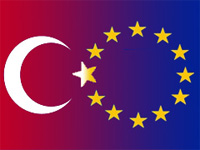
The primary question that the EU, and the rest of the world has yet to address, never mind answer, is whether Islamic culture and European (read Christian) culture can productively co-exist or whether we even want it to. Can we create a secular state where religion can play a central role in a person’s life, but not be part of the government to which he belongs? If we believe the answer is yes, then there is no doubt that Turkey has what it takes to be part of the EU.
The EU guidelines are a great power for good; they spread democracy, social institutions and transparency without guns or micro-management. The old European fashion of colonialism was effectively a heavy-handed way of introducing European style institutions into a foreign culture. The EU guidelines allow for a more macro approach. Guidelines and end-goals are set, and the countries that wish to join the EU must find their own methods of reaching the goals. This allows for stable nation building, which avoids many of the weak links in armed or colonial approaches. It takes longer, but it also lasts longer and penetrates deeper into society. The improvement of eastern European governments over the past 15 years is largely due to their adoption of EU standards with regards to government, social issues and business practices. I believe this same method can be used to help Turkey become a secular, stable state with an Islamic population. Turkey would then act as a model for other Islamic societies. It is evident that the heavy-handed approach in Iraq will not work; as such, we must re-think our approach to helping Islamic states modernize.

My recent trip to Turkey was very illuminating. To be completely fair, I did not speak Turkish and I only travelled to the most modern parts of the country. Tales from other travellers I met described eastern turkey as a truly third world area with little to no modern infrastructure. However, the situation in China – through which I travelled extensively – is not very different and yet they are progressing towards modernization at an astounding pace. One major issue that still hangs over Turkey, is their freedom of speech and their denial of the Armenian Genocide. It is necessary that Turkey take responsibility for their actions during WWI with regards to the Armenians. Their apologies must be whole-hearted and on a scale similar with those of post-WWII Germany and then they must be integrated into the Turkish education system. A cleansing of the Turkish conscience and a demonstration of their ability to be transparent is absolutely imperative if they have any hope of joining the modern world, let alone the EU. Of course, their potential membership with the EU will not come overnight; it will likely take 20 years.
I was really impressed with Turkey, its people and the general atmosphere. They were much more European than I expected. The question that remains to be resolved is whether Islam and Christianity can peacefully co-exist. The adhesion of Turkey would dramatically shift the demographics of Europe. Can such vast quantities of people come to agreements in an open government forum or do we need to separate them as is done in Israel. If we believe in their compatibility, then I think Turkey has a legitimate case at entering the EU and the EU has a fantastic method of modernizing foreign nations without direct intervention.
The Turkish Affair
I recently travelled to Turkey for 8 days. My itinerary was fairly brisk as I wished to see as much of the country as possible. The trip was as follows:
Antalya (1 day) → Olympus (2 days) → Izmir (1 night) → Sulçuk/Ephus (2 days) → Istanbul (3 days)

There were a couple of reasons I wanted to visit Turkey. I had previously read and heard great things about Turkey and I wished to see it to examine its potential as part of European Union. Prior to going, my opinion in relation to the EU was that it was too different, namely too Islamic, to be in the EU. The third motivation was to go more ‘east’ than my friends; Eastern Europe has become as backpacker friendly as Western Europe, and there remain few sites not crammed with Canadians, Aussies and Americans.
I was hoping to find some remnants of isolation in Turkey, though I did not have my hopes too high. In reality, the places I visited are on the top of the tourist hit-list and as such, were full of tourists – though more Aussies than I expected, largely, they come to visit the battlefields of Gallipoli. The Australians suffered massive casualties during the WWII battle of Gallipoli, which then acted as a catalyst for Australian independence, not unlike Dieppe for Canada. The presence of all these tourists may have impeded my visitation of ‘real’ turkey, but to be fair, not speaking Turkish and going for eigh days was not going to permit me to penetrate the Turkish society.
Antalya was a nice port city with little culture, but no lack of nightlife. While in Antalya, I took a day trip to Perge (45 min outside Antalya), an ancient Greco-Roman city, which was very impressive as a first site. The site, was very open and you could walk throughout the ruins with no security control. I then travelled south to Olympus, where the use of concrete has been banned. As such, all the houses are treehouses made of wood. The description of the town as, “an Ewok Village” was what motivated me to visit, the addition of bars and beaches was the cherry on the cake. While there, I visited the flames of Olympus, naturally occurring flames that are the source of The Olympic flame. I partied in an open roof club, surrounded by 100 m cliffs and jumped off 12 m rocks into the warm Mediterranean.
I then travelled to Izmir for a brief 6 hour stay before making my way to Ephus, Turkey’s most famous archaeological site. The town of Ephus is remarkably intact and is an amazing demonstration of what a 100 000 person Greek town looked like at its peak. After Selcuk and Ephus (same town really), I took an overnight bus to Istanbul. Istanbul was everything I had hoped for, a great blend of the Islamic and European world. Though three days were not enough, the mosques, churches and food were amazing. A little bit of partying in the newer, more European centre on the other side of the Bosphorous and then I caught a flight back to Paris to meet my father and board our sailboat.
My trip to turkey led me to two independent conclusions, which I wish to set on paper: Why Turkey may become a EU member and Why it is time to hang up the back-pack. Turkey was an amazing trip and I will definitely return; there remains so much history and culture, I could easily spend months travelling the country. You can see my photos here: Turkish Affair Photos
Apartments in China
Interesting new law in China that was just brought to my attention: All new housing has to have 70% devoted to apartments no larger than 90 sqm or 1000 ft. Click Here
Published on August 17, 2006All Roads Lead to Rome
 I do not have time to write anything, so here is a very quick guide to a few things in Rome that should be done by the backpack traveller. Profanity included.
Hear me now and believe me later,
In Rome make sure to go to the Borghese museum in the Borghese park, it has the best sculptures in the world. No exaggeration. It is small and you need to make reservations in advance as there are limited tickets but make sure to do that. Like as in if you do not do this museum and jerk off to some sculptures you will seriously be downgraded in my books.
Check out the all the tourist places and watch your wallet at all times. If the line up for the coliseum is ridiculously long (which it will be) you can get your ticket at the entrance to the park that is on top of the old school stuff just upwards of the coliseum. It is a dual ticket that gives you access to Nero’s palace and park and to the Coliseum (it is the same ticket you would get at the Coliseum).
Go to the gelateria near the fontana trevi, it is a very famous one and is a couple streets in back of the fountain and it has a big poster of an article in the new york times outside and it is probably the best ice cream in the world.
Try and hit up the other side of the river at the district called trastevere (or something like that). But since you do not have much time you may have to pass.
The vatican is pretty cool shit but the actual church is not. Check out the museum and when you head out there make sure to wear pants, not shorts (or they won’t let you in) and get there early or you will have to wait in line in the sun for a long ass while. The sistine chapel is sweet so take your time in there and check out the other cool stuff in the Pope’s crib.
There is a really good restaurant behind the church on the piazza navona and make sure to get buffalo mozzerella. The restaurant has posters on the outside of the place posted on the walls of the building and tables jammed packed with people and their might be a small line up. Make sure to eat outside and be friendly with your waiter and you should be able to get some free limoncello. It is on a street parallel to the piazza and is an offshoot of the street with all the little shops that suck in tourists, try and avoid those places.
There are a lot of small churches (notably one south the colleseum which used to hold the vatican prior to St. Peters and a small one on the road that is directly parallel to the ruins of ancient rome and the coliseum) that are less visited and very nice. do not try to buy drugs as the arabs will rip your balls off.
Also make sure to sign up for the pub crawl and get some flyers when you are at the vatican or at another tourist spot; or when you go to pay just bargain and say that you lost the flyers. It significantly reduces the price but the pub crawl is a lot of fun and you will definitely have a good time, al-might one with loud americans. The pub crawl I took starts at the piazza that has the hooded dude statue in the middle and is the only piazza in rome without a church. The pub crawl will be a lot of fun so hit it up friday or saturday if you are not too tired (as in if you don’t; you will be further downgraded in the Brun Hierarchy of living creatures).
Almost all the hostels in Rome are near the train station and, well, frankly, they are all kind of sketch; so don’t leave your valuable italian belongings in the hostel. Try and pick up some chicks to do the pub crawl with you and I guarantee you will get some serious foreign ass.
Spanish steps are prime real estate for pick pocketing lonely, clueless mexicans/italians, so be careful. Pantheon is very cool and the view from the Emanuelle II is solid as well as the museum that is to the right of it (when facing the monument) (NOT UNDER IT).
You will also notice water spewing out of fountains all over the city. The water is from natural springs found under Rome’s various hills (7 in ancient rome) but much more now. It was this natural source of fresh water that allowed rome to have up to 1 million inhabitants (a feat which was not equaled until industrial london in the 19th century). So that history lesson means you can drink the water from the fountains and if you don’t: you’re a tourist pussy.
If you want any more info contact me.
Check yourself before you wreck yourself,
Jonathan
Published on July 14, 2006Looking Back on My Middle Kingdom
I once read that if you stay in China for a week you can write a book; if you stay for a month, you can write an essay; if you stay for six months, you can write a paragraph; if you stay for a year you can write a sentence, and any longer, you can’t write anything at all.
I very much feel this is true, once you have stayed in China for a prolonged period you realize how complex it is. A quick glance, and you may think you have identified some key differences, but when you look closer you realize that it is not that simple.
I have wanted to go to China ever since I started reading about its emergence 5 years ago, while still in CEGEP. I knew I had to find a way to go so that I could experience the most possible with the smallest incurred cost. When I finally made it to China, I was asked by my friends if I had a “culture shock” when I arrived in China, the truth is I think I was well prepared mentally and my largest “culture shock” was actually when I got back to Montreal. I knew about the poverty and the injustice in China, but what amazed me was how kind and welcoming even the poorest of people could be when we sat down to talk with them. At the base, all humans have common desires; security, love, and comfort.
After seven months in China you realize how petty any problem you could have in Canada is. I have never worried about getting food, or escaping the police, or being confined to a life on a factory line. I genuinely feel that most people should travel to a third world country to truly see how the majority of the world lives.
I had the luxury of traveling all over China for work and for vacation. The country is vast and diverse and in many ways, cannot be grouped into one greater China. Many of the more remote areas are barely under the control of the central government and it is difficult to imagine a high level of devotion to the party. What this leads to, is an appreciation for what we have achieved in the western world, our complex institutions, respect for the law and our relative equality of living standards. Before leaving the developed world, you tend to take this for granted and assume that it is relatively simple to build such said institutions, when in fact, it is remains the greatest challenge any developing nation faces.
On a more personal level, I spent most of my free time with individuals who were significantly older than I. Most of my friends were 27 to 30 years of age, and without exaggerating, time spent with that age group will inevitably change the perspective of a 22 year old. Their life experiences, personal accomplishments, and responsibilities altered my view of what it takes to be successful. In China, I met more adventurous, more daring types of people than I met on my jobs in Timmins or Dunkerque (my previous two work terms). These people push you do more, move faster and work harder. I plan to go on more trips, experience more cultures and keep pushing hard.
It remains very difficult to quantify the effects that China had on me, but there is no doubt that it changed me for the better. I will likely return thanks to my positive experience and my base of Mandarin skills that I have acquired. Many things that I expected to find in China, I did not, and many that I did not expect, occurred.
Published on January 27, 2006