The next quiet revolution – how Wikileaks, Open-Data and Citizen expectations will change the world

Things change quickly. Prior to the 1960s, Quebec was run by Maurice Duplessis and the Catholic Church. Upon his death in 1960, a radical change in government took place as power over health care, education, and much of Quebec society, perviously held by the Catholic Church, was ripped away and given to a democratically elected government. This non-violent revolution took place in the span of one decade and lay the foundation for today’s society. Just as that revolution saw the power move from one shadow government, the Catholic Church, to a more representative government, today’s shift transfers power from the hidden parts of our government back to the people.
Western governments are crippled with debt, which simply means they are trying to do too much with too little. You can argue their management is inefficient, the systems are too old or they are not competent – either way, the people are tired of it and are demanding change. Citizens live in a connected, digitized world with email, Facebook, and other amazing tools. When citizens, especially young ones, arrive at a government website, a hospital or a public school, they fail to understand how they are run so inefficiently. Of course, these institutions have inherited decades of legacy technology and practices, but that is still not a satisfactory answer. The people have expectations and governments are failing to live up to them.
Three major pressures are coming down on governments around the wold – Citizen expectations, Open-Data and Wikileaks.
Citizen expectations are born out of their daily lives. They communicate through email, Facebook and Twitter, see photos and have access to amazing tools. They consequently expect governments to rapidly embrace these same tools to improve the standard of living and better deliver existing services. However, governments are often burdened with so much responsibility they cannot easily pivot and change according to new technology. It is thus important for governments to begin offering the raw data so that third parties – citizen’s, non-profits and business can help deliver services to society. This raw data feed is a new trend that is rapidly growing into the global Open-Data movement.
The Open-Data movement, of which I am part, requests that governments offer their information in a format that can be reused and turned into practical tools. Advocates of open-data want governments to open up their databases of information so that citizens can peer inside, see problems and help fix them. Citizens want governments to embrace crowd-sourcing, leverage experts in their communities and be more efficient. While many governments resist, we should remember the cries of outrage when parliament was first required to publish the Hansard, it is now consider obvious that parliament would act in a transparent manner for all citizens to see.
The third force acting on governments today is fear, fear of Wikileaks. Wikileaks illegally takes information from governments (and corporations) and exposes it for all the world to see. Even in democratic countries, governments have little experience with full and complete transparency. In many ways, the elected government is a superficial level of a shadow government which runs continuously through election cycles and whose power is out of sight of most citizens. It manages the society through meetings, diplomacy, statistics and more. In fact, Assange and Wikileaks want to pull the structure of secrecy out from underneath government bureaucracies. By removing the secrecy of their communication, Wikileaks forces them to either revert to secrecy, which slows down their operations, or open-up, which forces them to act in a moral and appropriate way. The best summary of Wikileaks’ motivation can be found here.
The traditional, semi-closed, hierarchical bureaucratic government institution has served well for over 40 years, but it is time to change. Citizen expectations, Open-Data and Wikileaks will change it by increasing transparency, efficiency and fundamentally making it more representative of the citizenship. Make no qualms about it, society is undergoing a revolution, but a quiet one. The power structure we have now will radically change as citizens and organizations push for honesty through transparency.
Published on December 9, 2010Resto-Net.ca exposes health inspections in Montreal
Open-Data is dear to my heart, since July 2010 I have been working at Montreal Ouvert to bring an open-data policy to the city. Open-data basically means that the government (in this case Montreal) publishes its information in an open, accessible and legal format that allows for re-use.
To show our fellow citizens the potential power of open-data, I convinced the amazing Jeff Wallace to build Resto-Net.ca. The site that takes the health inspections, currently available on the city website, and presents them in an easier to use format – along with some great analytics prepared by James McKinney. So, what is missing? A lot. The city should be doing the following:
- Publish the information in a machine readable format
- Create an API to get real-time updates of health inspections
- Publish warnings, inspections and other information – not just fines (which is what they currently do).
On November 11th, 2010, CTV News is airing a special report on health inspections in the city of Montreal and yours truly will be featured. Tune in at noon or 6PM.
To give you an idea of the fines our there, take a look at this chart:

Why a white poppy should replace the red poppy on your lapel this year

This year (2011) I will have 100 white poppies, I’m in Montréal, Canada – contact me to get one. For white poppies in Vancouver, click here.
After many years of patriotically wearing a red poppy, I have stopped. Why do we wear a poppy? The Canadian Legion considers it the utmost sign of remembrance for the sacrifice of our ancestors – 37 million casualties in world war I and over 60 million killed in world war II. Did the young men, women and civilians die for our freedom or for the politicians who gallantly led them into the muds of Europe from their armchairs in state capitals?
The dead did sacrifice, often with the best of intentions, but if we are to remember something, we should remember the good instead of the bad, the living instead of the dead. Peace, not war.
I firmly believe in the power non-violence and non-cooperation, it changes history – from Gandhi to Jaurès to Schindler to King to Mandela. Do not confuse non-violence with pacification; non-cooperation is the active battle against injustice through peaceful means. The Danes saved far more jews through non-violence than many countries did through violent action. We must honour the dead by reminding ourselves the folly of war; wearing a red poppy does not accomplish this, it simply propagates our reverence for military solutions to problems. This year, I will be wearing a white poppy, in vehement support of peace.
The Canadian Legion must recognize the power of the white poppy, because it has tried to ban it, claiming it infringes on their trademark. The power of peacekeeping is evident in Canadian history, we are a country born out of negotiation and one who embraces non-violence. Without descending into a history lecture, remember that Lester Pearson had the courage to send peacekeepers, instead of arms, to the Suez Canal – and it worked.
The white poppy is not a new idea, it dates back to 1933, when the Co-operative Woman’s Guild brought about the idea of commemorating peace instead of war. In his famous poem, “Flanders Fields”, John McCrae challenges us to take up the torch from the fallen and continue the battle with the enemy – but is the enemy the man across the mud or war itself?
In Flanders fields the poppies blow
Between the crosses, row on row,
That mark our place; and in the sky
The larks, still bravely singing, fly
Scarce heard amid the guns below.We are the Dead. Short days ago
We lived, felt dawn, saw sunset glow,
Loved and were loved, and now we lie,
In Flanders fields.Take up our quarrel with the foe:
To you from failing hands we throw
The torch; be yours to hold it high.
If ye break faith with us who die
We shall not sleep, though poppies grow
In Flanders fields.
Is the quarrel to be taken up with the unknown German soldier or with the people who send the patriotic citizens to their deaths? In WWI, over a quarter million people died or were wounded on the fields of Verdun in a matter of a few days, during WWII six million taking Stalingrad, and millions more continue to perish in conflicts today. We must stop the cycle of violence. There is great injustice in the world that must be fought, and it must be fought will all our bodies and souls – but not with guns.
Only resolution brought through non-violence can be lasting, war leads to war, just as WWI led to WWII. It was only through peaceful measures of post-WWII such as the Marshall plan, mass migration, the UN and the EU that peace in Europe was finally established. War begets war, peace begets peace.
Violence across the world has been steadily declining and while the tasks ahead remain daunting, a white poppy will help us remember that we must honour and remember peace, not death. Mahatma Gandhi prophetically said, “Non-violence is a plant of slow growth. It grows imperceptibly but surely”. We must fertilize the soil upon which it grows and that is why I will be wearing a white poppy this year, I hope you join me.
Published on October 30, 2010How to end prostitution
Prostitution comes in various forms and it is very hard to say where it begins and where it ends. People marry for money, the rich guy gets the girl, attractive female waitresses in scant clothes; people constantly use sex, or sexual innuendo, as a way of generating income. However, the actual practice of sexual intercourse in exchange for money seems a fair definition for “prostitution”.

Last week, a superior court of Ontario struck down a series of federal laws that were designed to criminalize prostitution (Globe and Mail Article, Big Think Article). In doing so, they have opened up the doors to brothels and the legal status of sex workers. In his decision, judge Himel makes clear that the decision is based on concern for the safety of the sex workers, not the morality of the practice. The two sides brought together 12 years of studies and data and the judge unequivocally decided that the safety of women in the sex trade was better protected if the trade was done in brothels, not on the street.
My thoughts on this issue have changed somewhat. I used to be in favour of judge Himel’s view, I felt that the current criminal system pushed sex trade underground and compromised the safety of the prostitutes. By making it legal, the trade could be monitored by the government and the health and safety of the people involved would be better cared for.
However, while my views on the safety of sex workers remains the same, the immorality of the practice is a serious consideration. By permitting prostitution, we indirectly (or directly) encourage the objectification of woman and their subjugation to the desires of men. While decriminalization may be done for the safety of the workers, a society that decriminalizes prostitution implicitly says it is an acceptable profession. I think the majority of Canadians would agree it is not a moral profession, so herein lies the rub. (Scary stats here).
A perfect society would certainly be free of prostitution, if we are not working towards that, what are we working for? The question becomes, how do you eliminate or reduce prostitution? Clearly, criminalizing prostitution does not work – there is prostitution everywhere in the world and its illegality endangers the very women you are trying to help. Criminalizing the client does help; in Sweden, the Sex Purchase Law has dramatically reduced the prostitutes and clients that trawl the streets.
As with most problems, prostitution needs to be tackled from the side. The root of the problem is that when the deals are done under the table, out of view of society, bad things happen. So, why not make the entire system transparent? If the people involved in the trade, both client and supplier feel their trade is a legitimate one, they should have nothing to fear. In Sweden, when men are caught with prostitutes, their names are published on a shame list. Prostitution has dramatically dropped in the country.
People who frequent ladies of the night should not be ashamed of it. I would say that those who support legalization of prostitution should be equally in favour of listing all the names of the patrons. I have no qualms with endorsing a baker I frequent or a plumber that helps me, so people in favour of open and legal prostitution should have no issue declaring who they frequent.
We can then use the reduced enforcement costs (courts, police, etc.) to fund education programs and job placement for women. As with anything in society, it is very hard to isolate factors – why do people frequent prostitutes? Surprisingly, many do it for companionship – which indicates another failure in society and in their own relationships. So, perhaps we might offer counselling to some of the people who frequent prostitutes for companionship rather than purely sexual reasons.
Why not let judge Himel’s decision stand, but institute a law that states, “The names of all prostitutes and all clients will be published on a website managed by the government.” Who could possibly be opposed to this? It might just solve our problem and help move society towards greater equality between men and women.
Published on October 3, 2010Can Twitter stop a genocide, or anything bad?
This idea came to me while visiting the Shoah museum in Paris for an exhibit of filmmakers who captured the horrors of the concentration camps. The exhibit demonstrated the power of film in conveying injustice and motivating people to rectify the situation. Prior to my visit, the story from the film Ferris Bueller’s Day Off was played out on Twitter. Each character would tweet his lines at the appropriate times (the movie takes place over the course of one day) and other characters would reply.
Some people claim that social media (Twitter, Facebook) allow for more democracy and communication, but do they? Twitter failed to change anything in Burma, Iran, or Xinjiang. Where has social media made an impact on real societal quests for freedom?
What if the historical events of a genocide – Holocaust, Rwanda, Cambodia, etc. were played out on Twitter and Facebook – would anyone notice or care? Would anyone do anything concrete? What if we played out a current crisis, would it increase awareness of the problem?
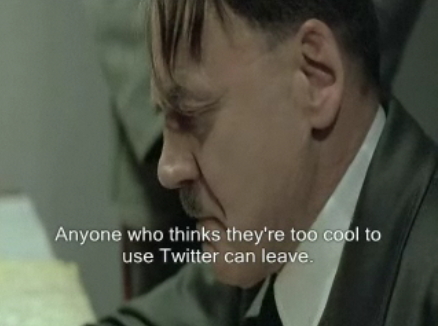
For example, for world war II, some exchanges might look like:
Each relevant historical figure (Hitler, Churchill, Shindler) would have a twitter account and say things that were true. For example:
Hitler – “All propaganda has to be popular and has to accommodate itself to the comprehension of the least intelligent of those whom it seeks to reach.”
Chamberlain “My good friends, this is the second time in our history that there has come back from Germany to Downing Street peace with honour. I believe it is peace for our time.“
Hitler – @Chamberlain “Any alliance whose purpose is not the intention to wage war is senseless and useless.”
Churchill – RT @Chamberlain “Any alliance whose purpose is not the intention to wage war is senseless and useless.”
Shindler – @Hitler “Power is when you have every justification to kill someone, and then you don’t”
Churchill – @Hitler @Musollini @JPEmperor “We shall go on to the end, we shall fight on the seas and oceans, we shall fight on the beaches, … we shall never surrender”
Roosevelt – “A date which will live in infamy“
Hitler – “The holocaust is the solution to the Jews final question“
Truman – @JPEmperor “The atom bomb was no “great decision.” It was merely another powerful weapon in the arsenal of righteousness.”
etc.
This could go on for a while. There was a very interesting debate about the good and bad power of social media such as Twitter. The two debaters were Clay Shirky and Morozon. Clay claims that twitter helps free people, while Morozon claims these tools allow oppressive governments to easily monitor dissidents. See the debate at the Edge.org here.
What about doing this for a current conflict by parsing headlines? We could do the Congo or Sudan.
Anyone interested to test this crazy idea?
Published on September 25, 2010