Personal Democracy Forum (PDF) 2013 – Thinking Small

For the second time, I attended the Personal Democracy Forum (PDF) in New York City in June 2013. The lineup of speakers was excellent, I got to see the great Ethan Zuckerman from the MIT Civic Lab, Sasha Issenberg, author of the Victory Lab, Robin Chase founder of ZipCar and many more. The conference was titled “Think bigger”, but despite the heavyweight attendees, PDF 2013 seemed focused on small incremental change.
There has been a recent war of words between technology detractors such as Evgeny Morozev and tech promoters such as Tim O’Reilly. Basically, Evgeny accuses much of Silicon Valley of paying blind faith to technology’s ability to solve problems. Some tech promoters argue that with more computing power, a better algorithm or distributed intelligence, social problems will be solved through innovation. Who am I to judge, but if tech evangelists’ faith were true, surely we would expect a better situation in 2013. If we applied a more technology = good equation; America, home to the most advanced technological firms in the world, should be the beacon of social justice and equal opportunity.
Many talks at PDF discussed volunteer mobilization strategies for elections, crowd funding campaigns, increasing transparency in politics and other applications of technology to politics, government and civil society. However, no speaker dared mention that only 55% of people vote in US Presidential elections and from the president to the city level, there are only two political parties in the entire United States. It seems the world of tech promoters confuses operational management with investment strategy.
In a government budget, you have two main sections – operations and major investments, they are distinct and managed differently. There is little doubt that open data and technology have an important role to play in improving operational management, we can automate, streamline, digitize and publish information for internal and external use. The nature of the government – autocratic, democratic or tyrannical – matters little to this, a pot hole is a pot hole is a pothole. However, applying technology to large scale complex social issues that require massive investment rarely provides meaningful improvement. If a system is fundamentally flawed at its roots, you cannot fix it with an app.
The world’s wealthiest societies’ list of societal problems are long and damning. Fifty years ago, who would have thought that the United States of 2013 would have over 2.2 million people in jail, 32 states would still have the death penalty and more than 50 million Americans would live in poverty? No technology can solve these failures. There is no such thing as a better death penalty, better segregation, or better poverty – there are only absolute goals. Despite our clear failings to address our most basic problems, the speakers and participants at the Personal Democracy Forum seem oblivious to the reality outside their tech bubble, or if they do know about it, they dare not whisper its name.
Many of these problems have been solved elsewhere. Yet, the people in power seem uninterested in solving them or perhaps they have their reasons not to. To maintain power you must do many things, but one key task is to be a master of distraction. You must deviate your potential competition from meaningful endeavours that might undermine your power. To get your most talented opponents to focus their forces on side battles is an essential tool in any ruler’s arsenal. In the same way magicians divert their audience away from their slight of hand, the powerful distract the competition from undermining their pillars of support. Yes, we must also have bread and circuses for the masses who might join with the competition. But the educated, wealthy, intelligent people at Personal Democracy Forum are the competition to the rulers, not the masses.
In many ways, too many projects discussed at the conference come across as side shows that will not fundamentally change anything. Just because you can engineer something, does not mean you should or that it will be useful. Nico Mele was repeatedly quoted as having stated, “The best minds of my generation are working on getting people to click on more ads”. I would add, “The best noble minds of my generation are working on incremental change to a fundamentally broken system”. We expose campaign finance trails on multi-billion dollar elections, we adopt hydrants in cities with rampant poverty, and we expose crime statistics while millions rot in jail. We must focus our resources on the root of our problems – not the symptoms.
Few, if any, fundamental questions were asked at PDF 2013. It seems all the speakers assumed that the current forms of government, voting and American democracy may be defective, but with just one more app, a little more elbow grease and some hard work – the system can be made to work. No participant or speaker mentioned our moral obligations to each other, our duty to sacrifice, or our need to rally around a common cause. Just apply an upgrade and reboot.
Here are a few words I never heard uttered at the conference: “sacrifice”, “common good”, “large government programs”, “revolution”, “increased taxation”, “new forms of taxation”, “constitutional congress”, or “attack pillars of support”. Everyone at PDF seems to believe that we can keep what we have and find innovative solutions to massive social problems. No sacrifices required.
TEDxMontreal, where I spoke, was sick with the same disease. One speaker at TEDxMontreal outlined a new stove he built for rural Indian villagers. The stove replaced dirty indoor open fires with cleanly burned pelletized farm waste, helping reduce lung diseases caused by smoke inhalation. At PDF 2013, a talk outlined a plan to deliver medicine to poor towns in in Africa with drone technology; no need for roads, simply fly in the medicine. These two proposals are massive cop-outs from fundamental, large-scale foundational projects of running gas lines and electric cables, laying rail and paving roads. Infrastructure projects have innumerable side benefits, one of which is to build community ties and lift a country to a new level of development. Compare India to China and the progress made in the last 35 years. Heck, compare the Soviet Union from 1910 to 1980 to Brazil in the same period. I dare you, look it up. Common sacrifice is what nation building is all about. There are certain massive investments that require sacrifice by all for the common good, something we need more of. We cannot shortcut success with technology hacks.
The list of patches to a broken society that were presented at Personal Democracy Forum was long. Some people argued that massive amounts of money in American politics was a non-issue because a favourite candidate with more money lost to a slightly less financed campaign. Or, if campaign financing is transparent, people will take it into account when voting. Any reasonable analysis demonstrates money in politics is a toxic force. Want a solution that does not involve technology? In Québec, we unanimously passed a law that limits campaign donations to 125$ per person per year and no corporate donations and campaign expenditures to 6 million dollars. This is the most progressive campaign finance law in the world. Removing money from politics (on both the revenue and the expense side) is fundamental to a functioning democracy. No app required.
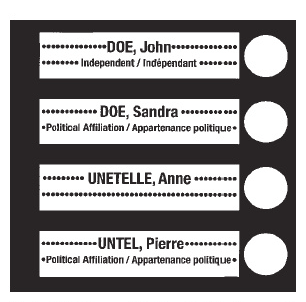
Think voting needs to be made more efficient? The team of Kate Kronis and Kathryn Peters are proposing new technology for running elections and counting votes. Do you recall the hanging chad technology of Florida? They have a solution – more technology! Want an easy to use solution with no technology, high accuracy and easy recount ability? In Canada, we go to the polling station, fill out an ultra-simple paper ballot and we then manually count them (see photo above).
Despite my cynicism, there are of course some interesting technological projects that could fundamentally change things, or be used by agents of change. I love the Pirate Party’s Liquid Feedback system, the new collaborative Icelandic constitution, driverless cars and online participatory budgeting. At Personal Democracy Forum, I felt too many of the bright talented people who could change the world were engaged in a small side games – not realizing the real power-play at hand. Bumping voter turnout by 1% when only 55% vote in a two party system is not meaningful success. They were blinded by the light of technology, hoping our next great technology will change it all.
In conclusion, I propose some actual big ideas that others have already implemented with great success: Free higher education, dirt cheap daycare for children, a base salary for all citizens, decriminalization of marijuana and other drugs, mass pardons of prisoners, mass debt forgiveness, a manned mission to mars, increased taxes on financial transactions, a new constitutional congress, a new election system based on preferential voting and mixed representation, strong privacy laws and no money in politics. Now put away the iPhone and get to work!
Links of interest
Larry Lessig on Republic Lost – Money in Politics
Clean Burning Stoves at TEDxMontreal
Drone medicine delivery
Law on campaign finance in Quebec
Evegny Morozev on Tim O’Reilly
Tim O’Reilly responding (can’t find it, but it’s somewhere on the internet)
Ethan Zuckerman Vancouver Human Right’s Lecture on the Arab Spring
Sasha Issenberg’s Victory Lab
George Packer: Can Silicon Valley Embrace Politics? : The New Yorker
Why you should care about government surveillance

“They who can give up essential liberty to obtain a little temporary safety, deserve neither liberty nor safety.” – Benjamin Franklin
For the same reason you buy home insurance, you should stand against government surveillance. The recent revelations of the National Security Agency (NSA) PRISM project that collects electronic communications are shocking – though not surprising. Under this program and others, the US Government actively monitors electronic communication of most Americans and most Canadians speaking with Americans. The NSA watches us in the name of security. They claim the collected information helps prevent catastrophic terrorist attacks, a sort of Minority Report that predicts crimes before they happen. We consent to this in the name of security. Is the exchange of freedom for temporary peace worth the cost?
If we define freedom as the freedom from oppression and the freedom to act as we desire, within the constraints of democratically enacted law, then it follows that we are no longer free. These surveillance programs remove your most basic freedom – whether you realize it or not. You cannot act freely if your thoughts, relationships, and speech are constantly monitored and analyzed; you end up in constant fear of oppression by the state. Did you know Ernest Hemingway committed suicide due to depression, compounded by constant surveillance by the FBI because of socialist sympathies?
The threat of force is usually enough to exert power. With your phone records, emails, Facebook messages and GPS locations; one day, when convenient, the people who have this information can ruin your life. Since the average citizen breaks three laws a day by speeding, paying cash, or fishing out of season – you are already guilty of something and the prosecutors already have all the evidence they need. No matter how hard you try or how good you think you are, you will break the law, some law, and the record is stored in a server farm, not so far away. Of course you will likely never be prosecuted, but one day that can all change.
Most of us buy home insurance to protect against catastrophic events – fire, flood, or tornadoes. We fear losing something precious and expensive, so we pay a fee just in case. Since you could opt for a vacation instead of insurance premiums, you are sacrificing current pleasure for peace of mind. With massive government surveillance programs, nothing stands between a zealous prosecutor (read: flood) and a destroyed life. A principal lever to restrict power is to restrict information. The creation of barriers between government and citizens might cost security today, but they offer freedom tomorrow. The power of government is well demonstrated by the prosecution of activists. This year, when faced with 25 years behind jail and mountains of legal bills for trying to help free publicly funded information, Aaron Schwartz killed himself – like Hemingway. Bradly Manning, the person behind Cablegate, is in jail indefinitely. Mandela spent 25 years in jail. The list is long.
It is not just activists who need fear the hammer of the judge. The well intentioned citizen who may have toked up in college, drank one too many beers, driven a little too fast or forgot to declare a little income has just as much to fear when those above him know every detail of every mistake he ever made. Want to run for mayor or take down a crooked politician? Forget it. Your competitors have all the details on your mistress, your drinking habits, and they can bring out that email you sent to your ex-girlfriend after a few too many drinks. The threat to harm is as powerful as the actual blow.
Freedom costs something. If we want a free society, we must give up certain short term comforts. We decided that our justice system should let some guilty criminals go free to ensure fewer innocent citizens are jailed. Today, we presume innocence and the government must prove you are guilty without a reasonable doubt. Mass surveillance removes the barriers between the citizen and the government, the consequences are a shackled society where we all live in fear and our actions are restricted. Freedom requires walls between centres of power, it requires limiting what government, companies and each of us know about each other. To know everything about everyone is to be all powerful. A surveillance state is the closest thing we have to an all-knowing, all powerful, judgmental Catholic God who sends us to hell for our inevitable sinful thoughts.
Democracy was conceived to remove absolute monarchs and distribute power amongst the people. Lincoln’s democracy, based on a “government of the people, by the people, for the people” will perish from this earth if it possesses a window into our minds. If you voluntarily give your hard earned liberties to secret government courts, private interests and power hungry institutions, do not expect them back anytime soon. If and when they decide to come for you, it will be at their convenience. The bag-men don’t come when the sun shines and the world watches, they come at night.
********
The well known poem by pastor Martin Niemöller rings very true.
First they came for the communists,
and I didn’t speak out because I wasn’t a communist.
Then they came for the socialists,
and I didn’t speak out because I wasn’t a socialist.
Then they came for the trade unionists,
and I didn’t speak out because I wasn’t a trade unionist.
Then they came for me,
and there was no one left to speak for me.
Links of interest
- Hemingway committed suicide because of surveillance
- Memories of Stasi
- Rundown of PRISM scandal
- Q&A with Snowden
- Great video interview with Snowden
- No Freedom without Free Software
- Privacy and the threat to self by Flynch
- The Irrationality of giving up this much liberty to fight terror
- Rex Murphy’s idiotic criticism of transparency
- Lincoln’s surveillance state
Open Data Muscle

Canadian open data needs to get pumped up! In the past year, the UK government has announced a 10 million pound investment into the Open Data Institute and the Google Foundation gave over 1.6 million dollars to the UK group MySociety and over 2.1 million to the US Sunlight Foundation. In Canada, we have yet to see a similar engagement from a government, a private individual or foundations.
Without adequate resources, the open data enthusiasts in Canada will be unable to compete with their UK or US counterparts. The limited supply of software developers who are passionate about technology, transparency and government will be drawn to companies that can put bread on the table. Jurisdictions with political leadership and who offer long term financial backing to talented developers and designers will develop the open data ecosystem first. Their technologies will eventually be implemented in Canada, when the data becomes available, but the brains and jobs will stay firmly planted offshore.
Canada’s Scientific Research and Development program supports thousands of tech companies across Canada, but non-profits are ineligible. Québec poured money into video games and aerospace, Ontario supported Waterloo’s RIM and the car industry and Alberta has the Tar Sands. We need an investment program for government data analysis and use. If open data apps can improve government and public service performance by just 1%, the returns will be massive.
Despite lots of talk, no provincial, municipal or federal government in Canada has shown leadership on open data in the form that matters most – money. Like it or not, without substantial financial support from government, projects such as OpenParliament, What Do They Know, Represent or MaMairie cannot survive. In addition to user facing applications, groups across the country need support to ensure our outdated access to information laws are reformed, that democratic institutions are modernized and that citizens take action on pressing social issues. If Sweden brought its deficit from nearly 80% of GDP to under 33% through the modernization of its democratic institutions, we can do the same and open government is part of the solution.
Jake Porway, of DataKind, recently wrote a great piece in the Harvard Business Review outlining the need to increase the financing behind open data. We need to somehow convince Canadian foundations, citizens, companies and governments of the pressing need to invest real cash into open data and apps. Without the build up of talent and resources, weekend Hackathon projects will continue to be just that: weekend projects. We need institutional capacity to affect political change. Who will have the courage to take a risk on Canada’s burgeoning open data community?
Published on April 11, 2013The Value of Democracy

Civic participation isn’t for everyone. In the non-profit and democratic fields, we too often attempt to convert the general public to our worldview that all citizens should be actively engaged in their communities, participate in votes, attend public assemblies and actively engage with their elected officials. This idealistic view of society drives many folks towards apathy and a perception that we’re a bunch of goodie-two-shoes.
If we are honest, most folks want a safe neighbourhood, a strong economy and fair opportunities of their children to succeed in society. While those elements absolutly require strong democratic institutions and an active population; we should not expect everyone to get engaged. The vast majority of our lives are managed by other people, plumbers plumb, electricians electrify, aerospace engineers build airplanes, painters paint, and bakers bake; why should democratic institution building be different?
Democratic activists improve democracy. Just as people are willing to pay for good plumbing, they should be willing to open their pocketbooks to improve democracy. The challenge then becomes to demonstrate the value of a strong democracy and its overarching impact on their lives and then allow them citizen to easily contribute towards our work. With the financial support of our fellow citizens, great things can be accomplished by the staff at Open North, the Sunlight Foundation, MySociety and other groups. The task at hand is to effectively communicate of the value of democracy and the urgency of change, two tasks that are harder than one might imagine.
P.S. Sorry for the lack of posts, see QuebecOuvert and Nimonik for my more recent blog posts.
Published on March 17, 2013Political vision and daringness

Today’s politicians seem to be play to the centre; not the political centre, but the intellectual centre. Instead of grand, bold, crazy ideas such as putting a man to the moon, eradicating horrible diseases, or fundamentally reforming society through constitutional amendments, they propose moderate reforms that risk few upset stomachs.
The lack of vision saddens me. In our times of global economic turmoil, changing world order and environmental challenge, we need bold people willing to take risks. Nations remember the dreamers and doers not the tinkerers, we love the ones who dared us to extend our self-image to new heights. Our fascination and admiration of these people is easily confirmed by a cursory glance at our history books or by polls such as the one that puts Trudeau as our most popular prime minister. While historical romance may not be the best test of quality leadership, it is a sign of their impact on the country. While Trudeau had more than his fair share of enemies and he put Canada on the road to financial catastrophe, we love him for his daringness and his refusal to compromise. We need more people like that.
Why are so few politicians willing to dream big today? The canadian David Foot once stated, “Two thirds of everything can be explained by demographics” and interestingly, the population during the tenure of many of our great leaders was significantly younger than today. The reckless youth that were once the base of change are now aging baby boomers concerned with cashing out their home equity and retiring in comfort. Our lack of boldness is due to more than an aging population, but it certainly plays a role.
As the thinker Slavok Zizek recently put it, “The philosopher Jean-Claude Milner recently proposed the notion of the “stabilising class”: not the old ruling class, but all who are committed to the stability and continuity of the existing social, economic and political order – the class of those who, even when they call for a change, do so to ensure that nothing really will change. The key to electoral success in today’s developed states is winning over this class… The majority who voted for him [Obama] were put off by the radical changes advocated by the Republican market and religious fundamentalists.” Though that might be an over-simplification of Obama’s victory, there is an essence of truth: the electorate seems highly risk averse and afraid to think of a different world that might be.
The the radical changes proposed by the tea party, the evangelical right, the Occupy movement and even the more moderate student protests in Québec were too much for the middle class to swallow. Yet, the frustration that has boiled to the surface on both the right and the left expresses a deep frustration with our political system. Our current trajectory of environmental destruction, increased debt and lack of social mobility must change much faster if we hope to avoid dire consequences.
From Drapeau in Montréal to Levesque in Québec to Trudeau in Canada, bold visionaries forge history, not the elected administrators we have today. The fact that the daring ones got elected and re-elected multiple times is a testament to their ability to enthral a nation, set a bold vision and execute – even if not perfectly. Today’s Canadian political landscape is sadly devoid of intellectual depth and leadership willing to upset the status quo or challenge our assumptions – yet, that is exactly what we need, more than ever (1). I’m convinced citizens are hungry for it; someone just needs to step up to the plate dare us.
In the private sector, Elon Musk is changing the world. After co-founding Paypal and selling it for billions, he set about revolutionizing the solar panel industry, creating electric cars and putting people in space. He aims to get us off fossil fuels and make humans a multi-planetary species, ambitious might be an understatement. Despite the grandeur of his goals he is succeeding. The Tesla Model S electric sedan just won Motor Trend Car of the year and Space X has launched two successful shipments to the International Space Station. He has created the greatest car in the world, that happens to be electric, and he has reduced space travel costs by over 95% (yes, you read that right). He did what most said was impossible and he did it with far less means than the current players in the market. If he can do it in technology, someone can do it in politics. We need a political Elon Musk.
P.S. Of course, the classic Apple Ad “The Crazy Ones” says this better than I can.
(1) See Foreign Policy top 100 thinkers and the lack of any Canadians on the list.
Published on November 27, 2012