Shifting the Narrative on Wealth, the State and Deserving People
In the excellent talk below, Yanis Varoufakis, Greece’s former Finance Minister lays out the compelling case for basic income. One of his key points, which basic income advocates should take to heart is the imperative to shift our social narrative on work, labour and the creation of wealth.
Yanis explains how we currently view the State and the private market as separate entities, when in fact they are one and the same. Without one, you cannot have the other. To convince people that a basic income is the logical and ethical thing for society to do, we must reframe the discussion as a dividend for the members of a society that produces wealth. There is no such thing as private wealth. All wealth is built upon the contributions of others – past and present. Without the invention of the internet and computers, I would not have my current job or company and without government, the internet would not exist – nor would the other private companies whose technology we use. Whether we like it or not, all wealth is communal. This point is also convincingly argued in Peter Barnes book, With Liberty and Dividend’s for All. If all wealth is created communally, then its benefits (or profits) should be distibuted to the community that created it. That is how dividend’s work for shareholder’s in a company and that is how a basic income could work.
Basic income advocates must also confront the other hard truth about a basic income: it is given to all and there are no deserving and undeserving members of a society. Not only is there no easy way to determine deserving vs. undeserving people, the very concept of designating some as deserving creates a power structure where bureaucrats can determine who is helped and who is not. I remember seeing a few years ago, in Toronto, a fantastic ad about why a punk on the street could not get a job. The ad was between the subway lines and about 10 ft from the viewer. It read, “Why can’t street kids get a life?” followed by large block of small text that could not be read from a distance, but presumably has a complex explanation, followed by “That’s why.” Life is complicated. A basic income would be a dividend for all members of a society to improve their chances in life – all while removing some of the arbitrary power government currently has.
Lastly, Vanis makes an excellent point that the wealthy already receive dividends and their children or relatives who did not earn the wealth are not terribly deserving of those dividends. Why does Paris Hilton deserve a dividend, but a kid from a working class family does not deserve one? In fact, both of them should have a dividend in the form of a Basic Income. I put this argument and others to a skeptical earner of a dividend, Stephen Bronfman who inherited money from his father’s business successes. Though he was unconvinced the beginning of the talk, he came around to being open to the idea by the end and I hope to fully convince him soon.
The time for basic income is coming, but to get us there we will need to shift the narrative we tell each other and our children about the origins of wealth and who deserves it. Wealth can only be created if there is a state and the rule of law and the more wealth we inherit, as a society or as an individual, the more wealth we can create. A society with inventions and discoveries to work off of, will create more wealth than a primitive society starting from scratch. Without calculus or antibiotics, today’s civilization cannot exist. A basic income is the fairest and simplest mechanism for us to create wealth while ensuring everyone can fully participate in society and reach their full potential.
On another note, Yanis Varoufakis book on the EU and the Greek crisis is fantastic : And the Weak shall Suffer what they must?. It provides clear (if opinionated) economic insights into the challenges of international monetary systems and the fundamental contradiction of a common currency between export nations (i.e. Germany) and import nations (i.e Italy). Canada overcame this challenge of export provinces and import provinces with a strong redistribution system between the provinces called ‘Equalization Payments‘. Québec has received about 5 billion dollars in annual transfers for the past decade, helping avoid the social and economic collapse as we see in Greece today. If you are interested in the history of the gold standard, Bretton Woods and the current impasse in the EU, the book is well worth the read. Also see his discussion with Chomsky on this topic and others.
Published on July 20, 2016
[:en]TEDxQuébec – Un revenu de base pour tous[:]
[:en][:]
Published on February 14, 2016[:en]On Haiti and Freedom[:]
[:en]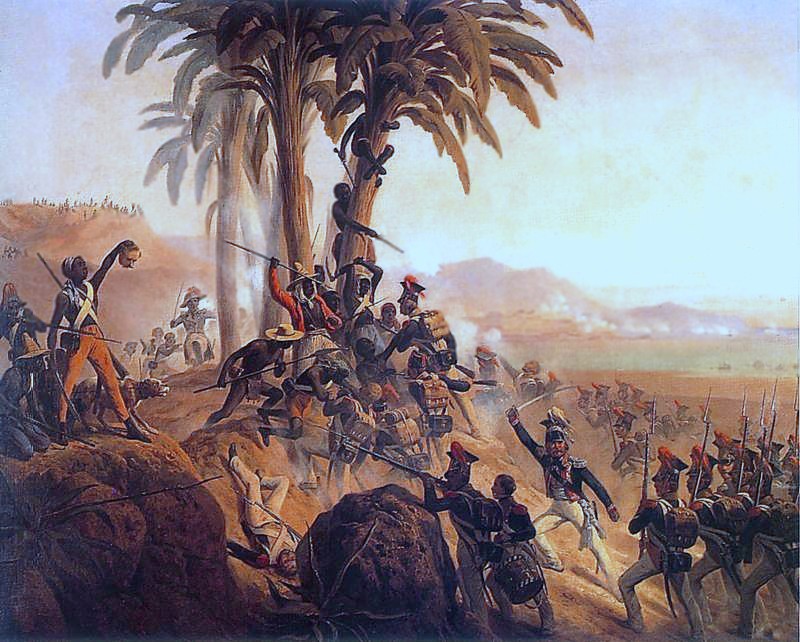
Haitians are a proud people and for good reason. They were the first colony to free themselves from slavery and overthrow a ruling class. The revolution, set off in part by the French Revolution, led to a bloody battle and punishing reprisals from European nations. Some two hundred years ago, one of my ancestors, Philibert Fressinet was a commanding officer in an invasion force sent to Haiti by Napoleon in the worlds then largest naval fleet to attempt to recapture the wealthy colony of Saint-Dominique (now Haiti) and re-instate slavery. In some ways, I wanted to go Haiti to absolve my ancestors sins and to see for myself what a revolutionary colony looks like. It’s not pretty.
I have travelled to poor places before – Ethiopia, rural China, Mongolia and others – but Haiti in 2015 is truly a place in desperate need of massive assistance. The Haitians fight for liberation started in 1791 and allowed them to free themselves from the bonds of slavery, but it left them in a political quagmire that lasts to this day. Walking through the streets of Port-au-Prince or smaller cities you see abject poverty nearly everywhere, yet you also see tremendous pride in the faces of everyday citizens. This fascinating contrast is difficult to explain. The expressions on their faces are different from any other non-white people I have met. Nearly all people of colour around the world were subject to colonialism at some point in time – everyone from the aboriginals in Canada to the people of Africa and Asia. When I visited Tanzania many people did not look you in the eye, their head and eyes turned downward upon sight of a white person as if to say they were subjugated. I would claim that this is even true in the United States with African Americans. An ingrained inferiority complex beaten into certain peoples takes generations to root out of a society. Some mouvements can accomplish the feat of instilling pride in a oppressed people and one of the most recent attempts was the Black Panthers, who led a fight for equal rights and dignity in the 1970s before imploding due to FBI sabotage and infighting. They had a similar image of pride in their eyes.

The leader of the Haitian uprisings, Toussaint l’Ouverture perhaps explained it best when he stated that he planned
“to cease to live before gratitude dies in my heart, before I cease to be faithful to France and to my duty, before the god of liberty is profaned and sullied by the liberticides, before they can snatch from my hands that sword, those arms, which France confided to me for the defence of its rights and those of humanity, for the triumph of liberty and equality.”
The Haitian people, if anything, are about freedom – freedom of spirit and of body. You can see this passion and righteous freedom in their eyes like I have not seen in may other people, except those of the ruling classes in other countries.
Haiti is tiny and mountainous an has over 10.32 million people who congregate in the valleys and near the water, making towns and countryside incredibly dense. The deforestation and its impacts on agriculture and sustainability are well documented in book such as Collapse by Jared Diamond. Simply flying over the country you can see the demarcation with the Dominican Republic, which has remained forested thanks to strictly enforced laws. All this to say that Haiti has a serious and not easily remedied problem: too many people and not enough land and resources.

The second main issue I could see in Haiti is that anyone with either an education or a bit of wealth leaves the country. This emigration empties of the country of a potential middle class. After the revolution some of its leaders got greedy and established a ruling elite not dissimilar to other central and Latin American countries. One leader, Henri Christophe ruled the north and even thought it was a good idea to reproduce, in exacting detail down to the specific titles, the aristocratic structure of Europe. This ruling elite has continued to exist until today and they seem to have little interest in developing the country. Much of the the aid money sent to Haiti often ends up in their hands. Without an educated middle class to counter the power of an elite, it becomes very difficult to establish the rule of law and build up an economy.
Third, foreign intervention is not new to Haiti. After the 1791 revolution and under threat of invasion, reparations estimated at 20 billion 2015 dollars were paid by Haiti to France for loss of property including Slaves. Successive interventions occurred over the years up to the American invasion in 1915. Today, foreign intervention is more subtle, but it is a major influencing factor on the politics and opportunity for the Haitian people. From controversial deals that prevent the application of Haitian law in a section of the North Coast and potentially an island Carnival Cruises has leased out land for foreign tourists to enjoy. The massive investments by foreign embassies, aid organizations and other non-profit groups has an impact on the relationships between foreigners and Haitians and between Haitians themselves. These investments, often done behind back-doors, makes it challenging for an economy to be built as Haitians will often use aid money to buy products from China or the Dominican Republic instead of building factories for their own production. In short, a system of dependency has been created that is sadly aligned with some of the interests of the ruling elite and certain foreign entities.
It would be nice to say that I am optimistic for Haiti, but I fear I cannot be. With no president and increasing violence, Haiti seems to be in a situation that cannot easily be corrected. There are so many problems that any realistic solution would need to involve the relocation of millions of people, the investment of billions of dollars and the return of educated émigrés. If there is one thing Haiti undeniably has it is honour and pride in their remarkable revolution that is well documented in C.L.R. James book, The Black Jacobins. It would be a great victory to see Haiti prosper, but if there is any lesson to be learned from them, it is that one should not understate the power of foreign countries, corrupt elites and revolutionary fever.[:]
Published on February 10, 2016[:en]Four Ideas to Change the World[:]
[:en]Time passes by so fast, I have been busy at Nimonik and had little time to write about the things I see in this crazy world. Luckily, NASA just announced the discovery of a 0.98 similar planet, so we can have a back-up planet if we do not sort out issues here. We will however need some form of traveling device near the speed of light to get there, or faster. Elon Musk? If Elon cannot solve it, here are four ideas that I am really passionate about these days and that I think can change society for the better. Read on about them if you can, I hope to elaborate in more detail in the near(ish) future.
- Liquid Feedback – A system to make decision making democratic and fluid.
- Rolling Jubilee – debt annulment for medical debt or the creation of a debtors union to free people from quasi-debtors jail. Don’t forget to read the great 5,000 years of debt.
- Basic Income – Distribution of common wealth (land tax, spectrum charges, pollution charges) to all citizens on an equal basis. Great book here on Citizen dividends, another term for basic income.
- A Tax on Capital – reduce the influence of capital in society and encourages people to invest their money in active assets that produce goods and services, as opposed to become rentiers living off the work of others. Read Pikettys Capital in the 21st century, best book in a long, long time.
[:]
Published on July 23, 2015[:en]Response to The Walrus Prostitution Debate[:]
[:en]Here is a recent letter to the Walrus that I wrote. If you are interested in Canada, The Walrus is a great publication.
Traffic Jam
As the organizer of a recent debate on the new prostitution bill, C-36, I am familiar with the emotional discourse surrounding sex-trafficking numbers (“Dirty Tricks,” December). Both sides of the broader debate, for legalization and for abolition, have a tendency to distort statistics. And as Alexandra Kimball indicates, each side has a hidden agenda: the legalization camp sees money to be made, while the abolitionists see sin.
We cannot deny that this debate is a moral one, and not simply a matter of mathematical analysis. Should society simply condone the selling of sexual services, primarily by women to men? Progress requires equality, and the abolition of prostitution is a stepping stone toward greater gender equality. As long as it is profitable and socially acceptable for women to sell their bodies, the practice will continue. The solution is to remove the demand from the market and encourage women to seek alternative means of employment. Sweden’s prostitution laws (passed in 1999 and the model for Bill C-36) have led to a precipitous drop in human trafficking and the sale of sexual services in that country—numbers, yet again.
What’s clear: we must choose between believing our fellow Canadians sometimes have to resort to prostitution to earn a living, and believing that we can offer them something better.[:]
Published on March 5, 2015