Innate human behaviour – or what I have learned from my kids
When you are an adult, you can find all sorts of theories to explain the way the world is, the way the world could be or the way the world should be. However, it is remarkable how much of human nature is innate and quite easily observable as humans grow up. Here are a few things I have learned, so far, from my kids (1 and 3 years old now). Caveat : due their young age, I reserve the right to change my findings!
Ownership
The concept of private property is very strong. Even at 1 year old a child has internalized the notion of mine and yours and they defend their property (toy, blanket, bottle,…) with as much viciousness and courage as a high paid lawyer. They do learn to share, but let us just say it is not nearly as natural as the concept of possession. Perhaps this shows the limits of communism and the need for all societies to have a certain degree of private property to ensure we do not act against the basic nature of human beings.
Pressure
The ability to manipulate and exert influence starts very young. The main strategy I have observed so far is to simply wear down the parents with repeated demands or a steadfast refusal to cooperate. So far, in most cases, we have persevered through these battles, but if you are already tired the child can easily gain the upper hand – beware! The same rules are used with adults. Napoleon Bonaparte was famous for making negotiations long late into the night in an effort to tire out his opponents. I heard a rumour that the Americans got the Canadian delegation drunk when negotiating the Quebec – Maine border and consequently gained hundreds of kilometres of land. Relentless pressure works for both young and old.
Outsourcing Work
The desire to have others do work for you is present from the start. This somewhat connects to number two, but our three year old is adept at asking us to do things he could very well do himself – wipe his nose, get a toy,… etc. More and more we are insisting that he do any task that he is physically capable of doing and in general it works. However, I must admit that to expedite an activity – meals, leaving the daycare,… I will cave in and do things for him. In general, for both young and old it is critical that you let people do any task they are capable of doing themselves. It helps build confidence, autonomy and a sense of independence. I was once making salad with my 95 year old grandmother and I ensured she contributed as much as she could! She lived to 102, just saying!
Sleep
When the kids are upset/crying, it is usually because they are uncomfortable, sick, hungry or tired. The discomfort can be physical or mental. While you can’t magically heal a sick kid, you can feed and encourage a kid – a little snack will do wonders. Holding them upside down by their feet also will help get them out of a meltdown, which is very much an out-of-body experience.
Sleep, I am convinced, is the greatest cure of all. We have been “lucky” to have great sleepers, but I am also fairly convinced that there are tactics to improve sleep. A quiet, dark, cool room helps a lot. A bottle of milk is critical and in my humble opinion, society is pushing breastfeeding on women way, way too aggressively with detrimental impacts to the mothers and children. As a father, it is a pleasure to put my kids to sleep and that is possible because they take the bottle. My wife breastfeed until six months, but we introduce the bottle and formula early on (a few weeks old) and have kept it going since. It gave her the freedom to leave the kids, detached the kids a bit from mom and allowed them more flexibility in their schedules. We never stuck to sleep schedules and I am not convinced they really work. Kids should sleep when they are tired and play when they have energy.
We have never used white noise, but we have made an effort to ensure there is background noise when the kids sleep to ensure they do not become accustomed to silence and consequently wake up with the slightest noise. Shhh, shhh, one last secret – we put our kids to sleep on their stomach right at a young age. They sleep – waaaaayyyyy better. Sudden infant death syndrome is, as far as science can tell, linked to cigarettes and alcohol in the house, not sleeping on your stomach. Oh yes, one more thing, a friend of mine recommended giving the older kid mild doses of Melatonin to help him fall asleep (about 1 mg). It works. Studies out there have not seen any negative impacts.
One more tip, do NOT do co-sleeping with your kids. Mom’s who breastfeed a lot will tend to do this more as it facilitates feeding, but you then enter a vicious cycle where the kid will not only require to sleep with you, but will wake mom up for feedings all the time. Do not do it. We kept our kids in a separate bassinet in our room for the first three months and then transferred them to their own rooms and cribs with a firm mattress and clear instructions to not wake us up – it has worked fairly well I must admit.
Repetition
The solution to many problems in life is practice. Michael Jordan once explained that he repeatedly practised every conceivable play and setup so that during game time, he was ready for anything. With kids, repetition is critical. From a young age I made a point of pouring water over their head and eyes during bath-time so that they got used to it. They now have no problem washing their hair and having their heads soaked. Teaching them to swim is the same – repeat, repeat, repeat. We bicycle to daycare every day, rain or shine, snow or sleet, so they are used to that and actually relish the adventure (it is safe, don’t worry, Montreal has great bicycle paths). We also make a point of having our kids stay at our grandparents often (or as often as they will take them) to build their confidence in sleeping in other places and dealing without us. We just need to find some friends now who are willing to take them for a sleep-over! In short, I believe firmly that doing something repetitively (like writing) is the best path to building confidence – this is even more true with young children.
Conclusion
In short, my general parenting philosophy is mostly based on the work of Cesar Milan, the dog whisperer. If you watched his show where he takes trouble-making dogs and tries to correct your behaviour, you will have noticed that the conclusion to each show is nearly always the same: the owners have to change their behaviour. Dogs are simpler animals the people and are even more influence by their owners than children are by their parents, but the same fundamentals hold true. It is the parents who control the situation and the actions parents take or do not take are most of the reason kids behave in a certain way.
In the equine world, Monty Roberts, the horse whisperer, has demonstrated the same thing over and over again. A horse with bad habits is usually an owner with bad habits. Historically, horses were beat into submission (and may still are), but there are cooperative and intelligent ways to change a horse’s behaviour. I hope my tips do not come across the wrong way. Each parent, family and child have different realities an constraints. Gabor Mate is an excellent resource on understanding the human mind and its actual needs. My wife and I have been blessed with two health children, flexible jobs that allow for work at home, low cost day care and healthy grandparents who can help with the kids. Many people are not nearly as fortunate.
I can only share what I have learned so far and it will likely change in the future, but I want to point out that having children is awesome. More people should do it (see my post on population imposition). Too much of modern day society focuses on the negatives of having kids, when in reality, the positives greatly outweigh the negatives. My last point in favour of having kids is that to live the full human experience, the ups and downs, to see your own reflection in your children’s eyes, you must have (or adopt) and raise children. To opt for childlessness, when you have the health and finances to have children, is to miss out on the most fundamental part of life : to raise the next generation.
Published on December 11, 2022The coming Population Implosion
I used to worry about three things – Solar flares, Antibiotic resistance and meteorites destroying the earth. Now, my main concern for the future of humanity is a remarkable one: Population Implosion.
Since the 1950s, there has been an ongoing concern that our population would exceed the limits of the planet. The projections saw the population growing to over 13 billion people and consuming all of our resources, like a horde of locusts descending on Egypt. We were told by the UN and others that this growing population would lead to a variety of disasters. One proponent of this theory was Paul Ehrlich, an evolutionary biologist who had a lot of charisma and would go on mainstream television to promote the concept of a “Population Bomb”. He explained that the population would continue to grow until there were no resources left for it and it would then implode. This theory appealed to the general public because it had a certain algorithmic clarity. You could, on a graph, just extend the line of population growth from 1800-1950 and conclude we would keep growing at the same rate. But, everything he proposed with regards to population growth turned out to be completely wrong.

Interestingly the projections have proven stubbornly wrong and we are now faced with the inverse problem – a declining and aging population. What in fact happened is that with women’s education, easy access to contraception, general material prosperity and mass migration into cities – women just stopped having lots of kids. Despite the massive evidence, the general public still thinks the world is overpopulated and that it is getting worse. In fact, we face the exact opposite problem – way, way too few babies.
The book Empty Planet outlines how almost no country on earth is currently having more than 2.1 children per woman (the replacement rate) and most countries are well under that mark. Some demographers believe China may have a birth rate as low as 0.9 children per woman and in fact, China registered less than 10 million births in 2021. Despite lifting the one child policy, China has entered into a downward spiral that is likely impossible to reverse. In fact, this was recently recognized at the 2022 Communist Party of China Congress where the goals of China were shifted away from becoming the world’s largest economy per capita and only general GDP goals were proposed.

The reason we are entering into a depopulation spiral is a bit unclear to the general public who sees the population continuing to increase. The main reason the population has continued to increase for the past few decades is not because of babies per se, but rather because people live longer (or die less). However, as birth rates plummet and we have less children, there are less children who will ultimately have their own children. Your “birthing” population is decreasing, which enters you into a spiral that is nearly impossible to escape.

This issue is not specific to China and is visible in numerous other countries such as Japan, Korea, Italy and other places. Even developing countries are having far fewer babies per woman than any time in history. In short, a declining population is almost a self fulfilling prophecy. This means that population will likely peak very soon and we will be left with an old and declining population for the next couple hundred years.
To my knowledge, there is no robust analysis of this coming societal change. Certain countries such as Japan, Korea and Italy are already dealing with a population decline and an elderly population, but what are the impacts of such a demographic change on the entire world? Countries such as Canada (with over 400,000 immigrants per year for a population of 35 million) and the United States with over 1 million immigrants per year avoid population declines by bringing in people from other countries. This works, but only while there are immigrants. The other impact of immigration, is that the countries these people leave are losing some of their brightest and best minds and their young population – hardly a winning proposition for those countries. Even African countries have rapidly declining birth rates and almost no country on earth has a birth rate above 3.3 children per woman. Unless something dramatically changes (which seems unlikely) Earth will see a lot of old humans and then fewer and fewer of us. The current projections for working population decline in Japan, China, Europe, and the US are rather staggering.
What does a society with a declining population and many elderly people look like?
A population that is demographically dominated by one group will inevitably be politically dominated by that group – especially in a democracy. Therefore a country that is dominated by older people will lean more conservative, be more adverse to change and progress. They will allocate resources to preserve the status quo. Politically, older people tend to vote in a more conservative manner, they tend to innovate and change less. How many 60 year old people are starting companies or proposing to overturn cultural norms? Some, but few.

As the working population ages, more and more resources will be required to support them. With many countries already spending 30-40% of their budgets on healthcare, we can only imagine what it could look like in 20-30 years. If we thought COVID was bad in 2020, imagine a similar outbreak when 10-15% of the population is much older and more susceptible to a pandemic. To protect these people more cautious policies, more resources and more protection will need to be allocated. As a consequence it seems self-evident that a society that leans towards older people will have less innovation, more conservative policies and be able to produce less goods and services.

China is perhaps the country where this gigantic wave is hitting first. China, due to its one child policy, already has a declining working population. Travelling through China in 2015 I was already thinking to myself that this was peak China. In a sense, China will never have more freedom, activity and buzz than around 2015. It is likely that part of the economic boom in China between 1980-2020 was due to smaller family size and the concentration of resources in fewer children. There are studies that correlated the rise of Ireland and the “Celtic Tiger” to the dramatic reduction in birth rates in Ireland in the 1960-70s. As Irish families went from 8 kids to 2 kids, more resources could be allocated to those children and they were able to pursue higher education and contribute to society. Having those types of demographics temporarily places your economy on steroids as the young generation is coming up through the workforce, and the older, more populous generation, is still active. Eventually you start hitting a wall where the older generation moves into retirement and now the young generation is stuck footing the bill and dealing with high property prices and more conservative decision making.
In China, their period of insane expansion is at an end due simply to the fact the population is now shrinking. Because, as of 2015 the population is getting older and older and older with less workers, less activity and less creation of new ideas and eventually higher labour costs. Despite some government efforts, the birth rate in China remains somewhere between 0.8 and 1.3 children per woman (or maybe even lower) – which will lead China to HALVE its population in about 40-60 years. This is going to be wild – and by wild, I mean boring and depressing!
An aging population is a very big problem – a declining population is an even bigger problem. While there are obvious economic problems with a declining population – more resources going to support older people, healthcare costs, transport costs, and reduced consumption – the problem that worries me the most is the political impact. What does a society run by old people for old people look like? Japan may be the best current example of this and if there is one word that encapsulates its situation it is stagnation. Japan is just not innovating like it used to and one principal explanation is that more and more of the society is controlled by the elderly and devoted to servicing the elderly.
Interestingly I find very little concern for this issue among the people I speak with. Maybe that is why no action is being taken. When I raise this concern most people usually brush it off saying that less people may be a good thing – better for the planet, more space available, less social issues. The challenge is to understand that a declining population will not solve our environmental problems. Most people live their lives using the law of expanding gases. This law of physics explains that a gaseous substance will expand until it fills the space it has. The parallel is that people expand their consumption of goods and services to the limits of their financial capacity. Less people will just expand their consumption as much as they can. If housing prices collapse due to a declining population, people will buy bigger houses. If SUV prices decrease as they have over the past 20 years, people will get bigger cars. However, the ultimate limitation on quality of life is our ability to purchase or produce the goods and services we want. With less workers and more retirees, we are very likely to see continued inflation, supply chain problems and less purchasing power for the average worker. This will (and is already) leading to frustration which will turn into political problems (see Italy as a case in point).
Population implosion is going to be the biggest problem of our lives. Like Global Warming, which is a communal problem that no individual can meaningfully affect, demographics is a society level issue that has far reaching consequences and is out of any one person’s control. Having or not having children is contagious. When you are surrounded by families with many children, it becomes the norm and the expectation. Additionally, as people have children, countries must invest in the infrastructure – schools, daycare, … etc. It is a bit of a self-fulfilling prophecy. Between 1850-1970 we saw this trend of growing population and infrastructure for children. However, the inverse is also true – if your entourage is remaining single and not having children, you are less likely to have kids. Ultimately, demographics is an issue that has been creeping up on the world for over thirty years, but no one really noticed. It will have cataclysmic impacts.
Bibliography
The Sex Recession – The Atlantic
Empty Planet – book by John Ibbitson
Sex is going out of fashion – Thread
Published on October 20, 2022Ukraine and Non-Violence
A tragedy is a preventable outcome that ends in death. The current Ukraine war is clearly a tragedy, as are all wars. Western powers would have us believe that the Ukraine war is a just and noble cause that will end in a humiliating defeat for Russia. I would argue that anyone who has had a cursory look at Russian history will know they are a people capable of enduring terrible strife and suffering – the Napoleonic wars, Stalingrad, … etc. It is rarely wise to bet against the Russians in a war of attrition. The reality is that the western powers who proudly send arms to Ukraine are only in this war to see the Russians suffer, more than to see Ukraine triumph. Western powers do not seem to have a clear strategy or end game for this conflict and they are definitely not going to engage directly with Russia. One thing is clear, the European and Americans will happily see Ukraine fight to the last Ukrainian.
In no way do I claim that Russia is in the right, but it is critical to understand that right and wrong are not very relevant in war. War is war. Death is death. Suffering is suffering. Regardless of the morality of a conflict, the people who suffer are those fighting, their families, communities and all the civilians caught in between. The glory of war is deeply embedded in human our culture. As a father of two beautiful boys, I would never be able to see them fight a war. Whenever someone extols the glory of war and the justice of a cause I ask them to re-read the history of the first world war. The images of young men enthusiastically enlisting and travelling to the trenches, only to have their heads blown off and their intestines spread over the mud of Europe breaks my heart.


Let us remember that single day at Verdun, when over 50,000 men were killed. Let us remember the noble French soldiers who laid down their arms in protest, only to be executed by the French army. Let us remember that ultimately, the first world war was just a stepping stone for the second. In the harsh reality of armed conflict, there are only two possible outcomes. One outcome is for the enemy force to be utterly destroyed and the second outcome is that a negotiated peace settlement is found. In the case of the first world war, a bad peace settlement was reached before the Allied forces crossed into German territory. Had a good peace agreement been found, it is probably that the second war would never have happened. The desire to humiliate Germany and the long term scars of the Franco-Prussian war sowed the seeds of the second world war.
Even the second world war, with nearly 26 million deaths and untold destruction and horror could have probably been resolved without so much war. It should be recalled that the Allied forces did not go to war to defend the Jews, gypsies, Romas and homosexuals who were being massacred by the Nazis. The Allied forces went to war to defend their interests. It is my firm belief that a sustained and coherent policy of non-violence and non-cooperation by Europeans and the Allied countries could have undone the Nazis without so many deaths or the Holocaust. Of course, we will never know, but it is worth the thought experiment.
After the dust settled on the second world war Germany and its army were completely destroyed. This destruction and the wisdom gained from the first war was thankfully put to good use with the formation of the United Nations, the European Union and other international organizations that have successfully avoided large scale war ever since. As imperfect as these institutions are, they have likely saved millions of lives.
In Ukraine, there is only one outcome possible – a negotiated peace settlement. Ukraine cannot defeat Russia, conquer its territory and destroy its entire army and Russia cannot entirely destroy Ukraine. This reality sets the stage for a long war of attrition where the suffering will echo through generations of Ukrainian and Russian families. The geographic reality is that Ukraine is on Russia’s doorstep and it is a deeply divided country between Ukrainian speakers and Russian speakers. Wish as we might, no amount of hope or guns or aid will change that reality. Just as the United States would never allow Canada to be militarily aligned with Russia, Russia will not allow Ukraine to be militarily aligned with the United States. The pro-Western Ukrainians may desperately want NATO membership and EU membership, but the problem is that a big Russian bear lives next door. The Russian bear gets angry when you poke him in the eye.
The sooner we realize that a negotiated settlement is inevitable the better. For the sake of the innocent children, someone must force a negotiation through any means necessary. The best candidate for such a push is likely China, but so far they seem uninterested in taking a leading role in international politics. Regardless of the instigator, Ukrainians and Russians must find a way to live together because they are neighbours. Any reasonable agreement, as admitted by President Zelensky, will likely mean Ukrainian neutrality (like Mexico) and abandoning the adherence to NATO. This main mean internal conflict in Ukraine, but what other option is there? The path of perpetual conflict with Russia is certainly not in Ukraine’s interest. Ukrainians who fought in the Orange revolution and in the Maiden revolution want Ukraine to be a European country, but there is a geographic and historical reality that cannot simply be wished away. Unless Russia integrates Europe, which may have been possible back in 1991, but seems unlikely anytime soon, Ukraine will not be able to fully integrate Europe. This is ultimately a political problem that cannot be solved through military force. The most likely outcome is probably Russia annexing parts of Ukraine.
The Ukraine conflict is only the most recent war. Millions continue to die in conflicts in the Democratic Republic of Congo, Palestine, Iraq, Afghanistan, Ethiopia, and many other countries around the world. Though violent deaths are decreasing globally, there remains a great amount of work to be done to bring about peace in our time. On this Father’s day, it is my hope that father’s the world over will choose a path of peace and non-violence in the name of justice. There is no glory in death, there is only suffering and misery.
For more on non-violence:
World Beyond War.org
Einstein Institute
The Tyranny of Merit by Michael Sandel
I wanted to share a short summary of this really fantastic book on how meritocracy and our social dialogue around creating a meritocracy is not as productive as may have hoped. Even I am guilty of this, in my Québec TEDxTalk, I explained that a basic income would help level the playing field and make our meritocratic society more even. This may still be true, but I have said I no longer support basic income. Sandel believes that society should emphasize respect and dignity for work instead of encouraging ferocious competition in the hope that it will create more doctors, lawyers and entrepreneurs.
He argues that in a meritocracy, the “losers” (the poor and uneducated) are very bitter as they are being told that they are in fact, less desirable people. He goes through Rawls (his specialty) and Keynes and other philosophers to show the nuances and complexity of linking financial rewards with moral rewards. One telling thought experiment is asking how people would feel about an aristocratic society vs a meritocratic one IF they know how they will end up in life (rich or poor). This is in contrast to the story we are told about creating a just society and the way to do that – asking people about the rules of society telling them they do not know where they will land in life. His conclusion is that if you know where you will end up in life (rich or poor) and you cannot impact that change, you will opt for an Aristocracy. In an Aristocracy the rich are more humble as they acknowledge they did not earn their place in society and the workers understand it is not their fault they are poor. This may explain why support for democracy is eroding globally.
The book remained quite US Centric, but the point that there is a substantial social divide between the educated and the non-educated is fascinating. We often think of class as being based on money, the way you speak and the way you behave. In fact, today’s class system is heavily based on your education level and where you went to school. Sandel works at Harvard and lives in a bubble of highly educated and wealthy people so he is observing that side of the spectrum first hand. I think that this book needs to be read by people in parties that are supposed to represent the everyman, but in fact represent only educated people. One statistic that really popped out was that elected officials used to represent society – the percentage of people with a university diploma was (more) aligned with parliament – around 50% in the 1950-1970s. After that and today, elected officials are nearly 99% with a university diploma, which is much higher than the numbers in the US (about 25-30%). Who should then be surprised the elected bodies do not represent the majority of the country or people. Elected people already think they are more educated and better than the average person and this creates a condescending attitude that is felt by those who did not “win.”
Lastly, Sandel makes a strong point that winning in both today’s society and in past society’s is heavily dependant on luck and circumstance. We do not emphasize enough this fact and Sandel explains that if there is one trend he sees at University, it is that students feel much more today than 20 years ago that they deserve their success. This is contrast to all the data that shows that coming from educated and wealthy families basically assures you will reach certain heights of success – regardless of your natural talents (which you do not control anyways).
I will leave you with two favourite videos that enforce this point:
The head start in the race of life
9 Life Lessons – Tim Minchin UWA Address
Published on January 26, 2022Why Basic Income is not a good idea
This is a long post. A very rapid summary would be that basic income will likely exacerbate existing problems – inflation and individualism. Additionally, the basic income movement has no consistent messaging or underlying philosophy which makes advocacy and communication nearly impossible. It is unclear how this concept can be brought into the mainstream and reconciled with our current philosophical structure of linking work to pay. That being said, i still support a small dividend for all citizens based on our shared resources.
Download the PDF or ePub of this post here. Please send thoughts and corrections to jbrun@jonathanbrun.com
Table of Contents
Incoherence in the basic income movement 5
Private capital vs. Public Capital 11
Applying Simple Solutions to Complex Problems 30
Introduction
If 100,000 people in Switzerland sign a petition, the country must hold a national referendum on the subject of the petition. In a country of 8 million people, it takes strong organizational capabilities and a lot of motivation to obtain a hundred thousand signatures. The artist Enno Schmidt and other Swiss citizens launched a petition in 2012 asking Switzerland to implement a basic income. This citizen-based petition led the country to hold a national referendum in 2016 asking if Switzerland should investigate the possibility of a basic income. The Swiss voters soundly rejected adopting a basic income by margin of 76% to 24%. Despite its failure, this citizen drive for a basic income (BI) propelled the subject into global headlines and kicked off a flurry of activity in countries around the world. Through this Swiss initiative, basic income was featured in mainstream media and that is how I first heard about it. The timing of the basic income initiative matched increased talk of automation and inequality, which made for a potent mix of issues with a possible common solution. What if we could address inequality, automation, poverty and government bureaucracy with a simple and elegant solution – basic income? I was swept into this optimistic wave as I saw basic income as a means to solve many social problems with one program.
It should be noted that basic income is not a new idea. The idea has circulated in one form or another for hundreds of years. The current wave of support for basic income is in fact the third attempt to push this idea from concept to reality. Basic income researcher and advocate, Karl Wilderquist, wrote in 2017,
“Support for unconditional basic income (UBI) has grown so rapidly over the past few years that some might think the idea appeared out of nowhere. In fact, activists have been floating the plan – and other forms of a basic income guarantee (BIG) – for over a century. It experienced a small wave of support between 1910 and 1940, followed by a down period in the 40s and 50s. A second and larger wave of support happened in the 60s and 70s, followed by another down period in most countries until the early 2000s. Today’s discussion took off around 2010 and has grown in strength with each passing year. It is UBI’s third, and by far its largest, wave of support yet.”
He wrote this well before the current coronavirus pandemic which has laid bare the inadequacy of the financial support mechanisms for average people around the world.
More than ever, the promise of basic income remains truly tempting. The premise of basic income is that our government should create a program with five core pillars. The Basic Income Earth Network (BIEN) is the main international organization that advocates for a basic income and organizes research efforts. They define a Basic Income as:
“A Basic Income is a periodic cash payment unconditionally delivered to all on an individual basis, without means-test or work requirement.
Here are the 5 Characteristics of Basic Income
- Periodic— It is paid at regular intervals (for example every month), not as a one-off grant.
- Cash payment— It is paid in an appropriate medium of exchange, allowing those who receive it to decide what they spend it on. It is not, therefore, paid either in kind (such as food or services) or in vouchers dedicated to a specific use.
- Individual— It is paid on an individual basis—and not, for instance, to households.
- Universal— It is paid to all, without means test.
- Unconditional— It is paid without a requirement to work or to demonstrate willingness-to-work.”
This program would be a major simplification of the existing welfare programs and while it is not supposed to replace all income support, proponents do promote the idea that it could replace a myriad of existing programs. Progressive basic income advocates advocate for an amount that would be sufficient to have a dignified life and provide for the basics – rent, food, transportation – which would be somewhere between $1000 – $2000 per month in Canada. Though the Swiss referendum did not mention a specific amount in the ballot, the Swiss basic income advocates spoke about a monthly amount of over 2,000 Euros. Certain right-wing UBI advocates advocate for a much smaller amount. This of course puts them at loggerheads with progressives (more on that later). There are various permutations on the five pillars above (age, distribution mechanisms, citizenship requirements, etc.), which I will not address in this essay.
Since discovering the concept of basic income in 2012 I have participated in basic income conferences, read articles, research papers and books and watched videos and lectures on the subject. I also co-founded Revenu de base Quebec, a non-profit group that advocates for basic income in the province of Quebec, Canada. I also work with the Basic Income Canada Network and UBI Works – two groups who promote a basic income at the Canadian national level. In short, I was a passionate basic income advocate and I believe that I did my homework. Since 2012, basic income advocacy has been one of my main non-profit initiatives.
There are many arguments for a basic income – government simplicity, elimination of poverty, or reducing income inequality. However, I believe that the most powerful and significant theme in the basic income movement is individual freedom. Advocates explain that were we all to receive a basic income we would have a greater freedom in our life choices. A basic income would give us the money to refuse lousy work and demand higher wages. Basic income recipients could use the money to return to school, start a company, help their family or any other project that they may wish to pursue but could not do under the hammer of a nine to five job. As I explained in my 2016 TEDx Talk (in French), a basic income would act as a foundation under people’s feet – allowing them to build up their life with the knowledge that they have a certain financial stability regardless of the vicissitudes of life. Basic income is about levelling the playing field in life and giving everyone a fairer shot at success.
Trust me when I say I really thought basic income was the best solution to a series of social problems. There are clearly many potential benefits to a basic income, but the most commonly cited ones explain that basic income will:
- Solve problems such as government bureaucracy. By rolling a number of various programs into a single payment, we would do away with bureaucracy and needless expenditures.
- Fight inequality as large amounts of money would be transferred to those at the bottom of the economic ladder and taxes on the upper end of the spectrum would likely increase.
- Stimulate the economy as people would inevitably spend this money in businesses near them.
- Provide financial stability offered by a basic income would have health benefits for recipients, as seen in pilot projects. A stable revenue stream and margin in your monthly budget is critical for your physical and mental health. People would be able to eat higher quality produce thanks to this extra revenue.
- Allow people to choose their employment and say no to dangerous work they do not want to do.
- Lastly, a basic income would remove the stigma of applying for government support and the shame of requiring assistance.
In short, there are a lot of reasons to support a universal basic income.
With all these positive elements it took me a good deal of time to realize the flaws in the pro-UBI arguments. It was only by understanding broader frameworks that structure our economies, politics and societies could I realize the possible negative impacts and the inadequacy of basic income.
All social problems are complex. Any issue that we find in society – poverty, inequality, injustice – is often the consequence of numerous factors, some of which are obvious and some of which are not. When we advocate for a social policy, such as UBI, we are often thinking through some sort of analogy or framework. We may not realize the framework we are using, but it is there. Said another way, the opinions we hold rest upon assumptions. More often than not we do not even realize or think about those assumptions. Deep thinking requires us to do away with as many assumptions as possible and attempt think from first principles. The aim should be to think from the ground up to ensure we understand all the moving parts in a social policy that we are considering. We want build up our argument for a policy up piece by piece without over relying on existing knowledge, assumptions or analogies to existing policies. This type of thinking can be utterly exhausting and that is why we usually rely on assumptions and built-up experience to make everyday decisions. For that reason, we tend to hold conclusions that are not thought out from first principles.
The underlying assumptions we hold about the economy, morality, politics and other items will determine what conclusions we make. To take a particularly dramatic and polarizing example: abortion or the right to abortion, just the phrasing changes our perception. If a person believes abortion is about killing babies, they will likely be against abortion. On the other hand, if you assume that an embryo is not a baby until much later in the gestation period then abortion is simply a medical procedure. This principle of placing assumptions within arguments is a powerful debate technique. This foundational assumption is critical to your conclusion. Our assumptions on poverty, entrepreneurship, wealth creation, freedom and the human desire to work are foundational to our conclusions on basic income.
It has been said that gaining a generalist knowledge on a subject is easier than we think and gaining a specialist level of knowledge on a subject is harder than we think. In other words, it is easy to understand the basics of any system – from plumbing to electrical systems to the economy to the human body. With a few dozens of hours of work, you can understand most things at a general level. However, to become a good specialist at anything takes tremendous effort. To become a specialist of the human body you need to become a doctor, which takes thousands of hours. To become a good doctor, you need to practice for thousands more. Some statistics show it takes 10,000 hours to become great at something. I do not think I have spent 10,000 hours on basic income and economic subjects, but it definitely took me years to more deeply understand the workings of our economic edifice.
So, what has changed and why do I no longer support a basic income? I have thought very hard about this, and my conclusion is that basic income is not the ideal solution to our problems. Instead, I would propose a Federal Job Guarantee, capital allocation at age 18 and a National Dividend. We also need solutions for housing in urban centres which are specific to housing. I will keep thoughts on proposed solutions for another post. My main conclusion is that a basic income is not a magic solution and may in fact make several things worse.
It has been said that problems have solutions, but contradictions do not. What I have come to find is that the basic income movement has some hidden and underlying contradictions to which there is no solution. The following elements are the core problems and contradictions I see in the basic income movement. Some are problems and some are contradictions, the short version is that I see too many contradictions within basic income for it to work.
Incoherence in the basic income movement
One the most attractive elements of basic income is that it appeals to the left and the right of the political spectrum. Right wing people believe basic income will reduce government power by transferring decision making to the individual and reducing government bureaucracy. The left wing feels that a basic income will offer a dignified life to everyone and eliminate poverty. The recent US presidential candidate, Andrew Yang (who is also ran for mayor of New York City and is now starting his own political party), used this concept of uniting the left and right as his main electoral policy. He stomped across the US with a constant refrain that basic income is “Not left or right, it’s forward”. While this apparent conjuncture of political forces is appealing; the fundamental challenge is that the two political wings are talking about the same thing in name only. The fact that he lost by wide margins in all his elections is a clue to the challenge with the message. When you press the issue of bringing together left- and right-wing people into a movement you quickly discover that right wing basic income advocates do not want to spend more money than we are already spending while the left wing wants to radically increase the government budget. The two visions are completely incompatible and contradictory. Any movement built upon these two groups of people cannot go anywhere.
In their 2012 paper On the Political Feasibility of Universal Basic Income, Jurgen De Wispelaere and Jose Antonio Noguera (Paper) discuss the challenges of the basic income movement comprising many political points of view. The paper is well worth a read, but the main conclusion seems to support that there are fundamental incompatibilities between the members of the basic income movement that will prevent it from moving forward. Not much has changed since 2012. They outline the issues around conflicting groups supporting basic income and the fact that many of these groups are politically marginal,
“The problem of cheap support, as outlined in this section, poses something of an impasse for BI advocates intent on building a robust political coalition. On the one hand, many (if not most) current instances of expressed support may be of little practical use, and in some circumstances could turn “noxious” when support by some factions leads others to oppose rather than support BI. On the other hand, future support of any impact is unlikely in a political environment reluctant to spend political capital on a policy that remains highly divisive, both internally and externally. This makes it difficult to ascertain whose support to seek, and at what price. The underlying concern is that the very reason why political support is relatively easy to come by from marginal political individuals or groups—it is cheap in the sense of expressing such support having few costs attached—is also the reason why such support is relatively worthless to BI advocates. The main challenge to advocates intent on building a robust BI coalition is to find ways to get powerful political agents to express support and simultaneously, to ensure that such support is no longer cheap in either of the two senses canvassed above. Failure to achieve this is one important way in which the strategic feasibility of BI is hampered.”
Most of my arguments against basic income outlined in this paper are with the progressive and more generous form of it. A small basic income could work and may have some limited benefits, but where I see an impasse for the movement is in the bolder vision of a basic income that provides subsistence living to all. If we try to forget about the core incompatibility between the political wings of the movement, there are still substantial and fundamental problems within the progressive part of the movement. If we dive into the progressive arguments for basic income, we quickly see several fatal flaws.
The biggest red flag in the basic income movement is that there is no central theory or philosophy underpinning the movement. The communists had Marx, the capitalists had Adams, the social creditists had Douglas, and the social democrats had Keynes. To change society on the scale that basic income advocates propose you need more than a good idea – you need a philosophical structure with a portrait of how the entire economic and social system should work. This structure needs to both explain why the world is the way it is and what levers and switches need to be pulled to make the world as it should be. The basic income movement does have a few philosophical leaders such as Yannick Vanderborght and Philippe Van Parijs, but I have not seen either of them produce a comprehensive mechanistic vision of how a basic income society would work. Without this holistic map of a future society there are too many unanswered questions for the movement to cohere together through the difficult times that all social movements must cross before they reach the proverbial mountain top. When basic income advocates come under pressure during debates or arguments or with proposed alternative solutions, they do not have common references on how society works or what is wrong with it. Without a global framework to analyse society it becomes too challenging to piece things together and the arguments for basic income reveal their shallowness. Advocates inevitably stick with very high-level points such as “poverty is bad” and “automation will take away jobs”. Neither of these arguments are terribly compelling and there is little evidence for the latter.
Underlying the lack of a cohesive basic income school of thought is the fact that there is no common understanding of monetary systems amongst progressive basic income advocates. The average citizen does not understand monetary policy or the available options for the issuance, management and constraints that govern sovereign fiat currencies (US dollars, Canadian dollars, Yuan, Euros, etc.). Even within an educated and progressive group of basic income advocates there is no common understanding of what money is, how it works and what we can do with it at a government level. This is a very fundamental problem that undermines the entire edifice of basic income.
At the end of the day, basic income is the issuance or distribution of money to people so it would seem logical that the advocates of such a policy have a deep understanding of monetary and fiscal policies. There are basic income advocates who believe that crypto currencies are the solution, others who feel local currencies would be good, some who believe in balanced budgets, others who believe in large government debt, and others who have no clue how money is managed by a central bank. These visions are obvious incompatible. Until we agree on how the monetary system works and how it should work under a new basic income regime, we are going to have a very difficult time agreeing on what the government can and should do with the money supply. The various monetary approaches above are contradictory in nature – you cannot have a balanced budget and issue large amounts of government debt. Ray Dalio is the founder of the world’s largest hedge fund and he has explained that,
“For thousands of years there have always been three types of monetary system:
- Hard Money (e.g., metal coins, crypto currencies)
- “Paper Money” claims on hard money (e.g., U.S. dollar prior to Nixon removing its link to the gold standard)
- Fiat Money (e.g., the US/Canadian/Euro dollar today)”
With my apologies in advance, let me make a small digression into the functioning of these types of currencies. Firstly, hard Money which includes cryptocurrencies and bullion (gold, silver, …) coins are supply constrained. It costs lots of money to get the gold in the coins or to create the cryptocurrencies via mathematical computation. That means that each crypto-dollar/gold coin you create becomes harder and harder to create with a hard limit on total issuance embedded in the mathematical formulas of the cryptocurrency in question or in the gold supply. Crypto currencies may act as a decent store of value with no intrinsic worth (like Gold), but they cannot be used as currency. Because cryptocurrencies are limited in issuance, they will tend to increase in value as long as there is increasing demand for them. As such, it makes no sense to spend your crypto-currency on goods or services because holding onto the currency will be more profitable – it will increase in value tomorrow and the next day until the end of time. Cryptocurrencies are fundamentally deflationary – they increase in value every day. The currencies we use today are the opposite, they are inflationary – they decrease in value most days. Many of the same restrictions that we find in Hard Money apply to Paper Money because Paper Money is tied to Hard Money, so I will not dive into that in much detail.
In a growth-oriented economy, such as the one we live in now, it is critical that we have inflation. Inflation forces people and businesses to invest money and assets into productive activities. Inflation incentives spending your currency on projects that will have a return. As such cryptocurrencies are completely incompatible with a growth driven economy or Keynesian economics. Anyone who advocates for bitcoin/gold to be an actual currency used for commerce on a large scale should be laughed at. Within a fiat money system, which we currently have, there are a myriad of options and twists and turns that can be done with monetary and fiscal tools.
Leaving aside the “hard money people”, even basic income advocates have no common agreement on how our fiat system currently works or how it should. The investor Ray Dalio goes on to explain,
“So, it’s important to realize that 1) most money and credit (especially the fiat money that now exists) has no intrinsic value, 2) it is just journal entries in an accounting system that can easily be changed, 3) the purpose of that system is to help to allocate resources efficiently so that productivity can grow, rewarding both lenders and borrowers, and 4) that system periodically breaks down. As a result, since the beginning of time, all currencies have either been destroyed or devalued. When currencies are destroyed or devalued that shifts wealth in a big way that sends big reverberations through the economy and markets.”
Understanding what money is critical to your world view. Most people think of money as a physical object you exchange for goods and services. They think that the government has a limited supply of money and that governments need to balance their budget like families. In a fiat currency system (which we have now), this is not true. The assumption that money is somehow supply limited is patently false and undermine people’s imagination of what the human species can achieve. The only thing that limits what humans can do are the laws of physics. Anything that is physically possible, is possible. Money is a resource allocation tool – nothing more, nothing less. However, there are restrictions on how much money you can print, the overwhelming restriction on money issuance is: Inflation.
Inflation is very real and is a limiting factor on how fast society can move forward. That is to say, if the government issues “too much” currency and spends too much then there will likely inflation. The only real way to know if government is spending too much is to look at inflation. If there is no inflation, then it is likely that we still have lots of room for growth and investment in productive activities. If you start to see inflation, then the government needs to pull back. At the time of writing this (November 2021), inflation is now around 4.5% which is the highest in decades. This is likely the consequence of massive government spending during the COVID pandemic and bottlenecks in the supply chain due to changing consumption patterns. The main question economists are asking is if the inflation is here to stay or if it is just a temporary blip caused by changing consumer patterns. We shall see.
The way we think about money shapes our world view. If a person has an underlying belief that money is physical and that society has limited resources then you tend to tend to favour degrowth and stagnation. This point of view is remarkably popular in society and the advocates of restricted government spending are usually those who already have a large amount of assets or a world view that is based on the false idea that our money supply is somehow limited (it is not). If you have lots of assets, you are not going to favour a devaluation of those assets. If inflation and growth is broad based within society and based on increased productivity or on new activities, then it will tend to devalue unproductive assets. Some of my ancestors in France were wealthy aristocratic landowners, when the industrial revolution came around their wealth was inflated away as factories and produced goods dramatically increased society’s wealth – but the farmland they owned did not increase in value. Consequently, their wealth was inflated away. The topic of economic growth, inflation and deflation are vast topics which cannot be fully addressed here. Suffice to say that basic income advocates need to have a coherent narrative on what they want to change when it comes to government budgets and the creation of inflationary forces to drive long term economic growth. Currently I do not see any coherence in the basic income movement on these topics.
UBI would be a major overhaul of our current fiat system and advocates need to have a clear understanding of how it would play out. Without this common understanding no one will take basic income advocates seriously.
Poverty Alleviation
The progressive wing of the basic income movement has a core motivation: eradicating poverty. In Canada, the Basic Income Canada Network has been advocating for basic income as a poverty eradication policy for years. Progressives will say things like “A poor person is not poor, they just have no cash” or “basic income is not left or right, it’s forward” other such catch phrases. Advocates claim a basic income would not only help eliminate poverty, but it would also remove the stigma attached to applying for a variety of government programs. Poverty elimination is critically important to our society, but the question we should ask is not “is poverty eradication good”, but rather, “Is basic income the best option to eliminate poverty?”
When you confront basic income advocates with alternative methods for poverty alleviation, such as a jobs guarantee, or with alternative methods for reducing inequality, such as new taxes – you start to get to the “real” reasons they want UBI. Push hard enough and a basic income advocate will admit it is about individual freedom – the freedom to choose your destiny and refuse to work. Push even harder against their proposals and advocates will staunchly defend that even able-bodied adults should not have to work to live. This implies several problematic things from an economic, political and philosophical point of view.
There is a well-known parable of two British shoe salesmen who went to Africa in the 17th century. The first salesman returned in dismay, “Disaster, Africans don’t wear shoes!”. The second salesmen came home with enthusiasm for his sales prospects, “Wonderful! Africans have not bought any shoes yet!”. As overly simplistic as it might be I think you can divide almost all economic arguments along these lines – are you optimistic on growth or pessimistic on growth?
Underlying the belief that all able-bodied people do not have to work is an assumption that we are already producing too many goods and services. Some basic income advocates believe that automation is already here and is only accelerating, making labour that much more irrelevant. On the other hand, I and many others believe that there is a tremendous amount of work to be done in the world. There is infrastructure to build, schools to run, people to help and a green energy revolution to be executed. We need workers to make this happen. These large-scale projects cannot be done by individuals in their garages, they need to be done by large organizations with millions of people. This fundamental perception of society that we are either already at maximum desirable production or that we have much further to go will inform many conclusions a person will hold. These two views are incompatible – we cannot believe that there is already too much production and believe there is not enough production. You need to choose a door – progressive basic income advocates mostly believe there is already too much production.
As discussed above, money is mostly about resource allocation. You can put money here or there, it the primary way to say “this job needs to get done”. There is a lot of waste in our current resource allocation, but there is less waste than in most alternative systems. The reason communism does not work is that it is very bad at resource allocation. The vision by basic income advocates that we are already producing too much and that automation will further erode job opportunities is, frankly, insulting to those in low-paid, but high value jobs – teachers, nurses, food production, people in waste management,… etc. Too often, the educated classes of society fail to appreciate the vast underlying working population both in our own country and in low wage supplier countries that underpin our modern civilization. There is not shortage of work to do and there is no shortage of people who deserve a pay raise for the work they do.
It has been said you can divide the world into two categories, those who see the world as two camps and those who don’t. Joking aside, there is often a dividing fundamental assumption that we see in nearly all social, ecological and political justice battles. If we take the current issue of automation in the economy, we quickly see two camps of people. There are people who presume we will run out of jobs as AI and robots replace humans. Then there is the other camp who believes robots and AI will allow humans to do new and exciting work that does not yet exist. Similarly, in the environmental defence movements you see two camps. There are the de-growth people who want us to reduce consumption and return to the land (extreme examples) and then there those who believe we can invent solutions to our environment problems (see electric cars as an example).
If you hold the view that we are already overproducing (and over-consuming), then you will conclude that we should focus on degrowth, reduce our total carbon footprint, and share the remaining work. Out of that you need to create a social and economic system that is not predicated on GDP growth, population growth and or increases to the money supply. This world view is hard to build and even harder to execute because it goes against the impulses of humans who typically want to increase their quality of life and that of their children. The entire edifice of our money, political and social narrative is based on growth and progress. We are told that if we study and work hard, we can improve our quality of life. Our debt-based society requires growth to finance increasing debt payments. If we were to change society to be based on economic and population stagnation as some basic income advocates imply (though do not state it explicitly) – we would need to completely restructure our societies. This seems challenging to say the least.
If you take the opposite opinion that there are hundreds of millions of jobs to be created – then basic income makes little to no sense. There are other large scale social programs that we would use to address some of the underlying problems basic income claims to solve. One of the main proposals is a federal jobs guarantee. Like basic income, a federal jobs guarantee is not a new idea. It dates to the New Deal of the 1930s and proposes that the federal government use its ability to print money to create jobs for the unemployed and direct those jobs to projects that will enrich society. The idea of a jobs guarantee is that it is a temporary solution that comes and goes as the private market expands and contracts during recessions. It is critical that government money be put towards productive projects and government spending should only be reigned-in if there is inflation in the economy. Franklin Delano Roosevelt did this and lifted the United States out of the Depression. To a large extent, China did this too. Some progressives today propose the same approach with a massive investment in “the caring economy”. This would be spending directed towards activities that heal and improve the world. We would invest in clean energy to improve the environment, invest in healthcare and elderly care and invest in education and day-care to nurture our youth. This is just one proposal amongst many. Could we do this type of investment and job creation as well as a basic income? There are two reasons we cannot do both a jobs guarantee and a basic income. First, it would probably be too expensive. Secondly, the two are philosophically opposed to each other.
What makes a government program too expensive? Fundamentally a program is too expensive if it causes inflation or if it pulls resources away from more productive activities. This is difficult to determine prior to the program. As with any investment, the government needs to determine what the social, political and economic return on spending will be. What are the alternatives to this spending and are they better or worse than the proposed program? Once this analysis is done then we can determine if the program is too expensive or not. If we take these two broad options – a federal jobs guarantee and a substantial basic income we can see quickly that a jobs guarantee has two clear benefits – increased consumption power and increased production, a basic income just has the increased consumption side.
Why are a (large) basic income and a federal job guarantee incompatible? When you propose alternatives to a basic income such as a job guarantee or additional government programs, the response from basic income advocates is that we should not create workfare. Workfare is the idea that government creates work so people can get paid and then requires people to work to obtain access to government money. Many will argue (with some merit) that this type of government spending leads to tremendous waste. It does. However, it should be looked at in comparison to the alternatives. The alternative is to do nothing and let people live in poverty with no disposable income and no meaningful work. The other alternative is to just hand out money, which will likely lead to inflation and reduction in working people’s consumption power. A massive basic income may in fact start a true battle-royale between net recipients of basic income and working people. In no way does society benefit from unemployed people. Our aim should be to minimize unemployment and simultaneously direct people towards work that enriches their lives and enriches society. In contrast to a jobs program, a basic income also has far fewer benefits in terms of retraining displaced workers or helping people find dignity or contribute to society through work.
When I put pressure on basic income advocates about this challenge of the importance of work in people’s lives, I get a myriad of answers. If we begin to talk about the amount of money that should be given via a basic income, most progressive basic income advocates have a proverbial red line they will not cross. They will compromise whether it is universal or just a negative income tax – but they will not compromise on the conditionality of it. Basic income must be unconditional or else it is simply not basic income. This means it cannot be based on your ability to work or any other criteria aside from your income (in the case of a negative income tax). Again, this brings a basic income into fundamental contradiction with government job creation programs.
The Australian comedian Jim Jeffries has an excellent bit where he analyses attitudes about guns in America. Americans will claim their right to bear arms is in the constitution and they should therefore be able to own, carry and use guns. Americans will claim it is a fundamental right. However, nearly all gun owner advocates will eventually agree that a few guns are not going to protect you from the American government who has the most powerful military in the history of the world. When you press gun advocates about why they really need a gun you will get a simple answer: guns are fun. It is fun to hold a gun and even more fun to shoot one. It makes you feel strong, independent and shooting and blowing up things is genuinely fun. That being said, guns are dangerous and many countries have banned or heavily regulated them. Boo hoo, less fun for you! As a society we often have to choose between fun and a healthy society (see restrictions on alcohol, drugs, polygamy,..). Putting restrictions on money is also critically important to the health of a society!
In a similar way to guns, basic income is fun. It is the ability to live off the production of others. Living off the production of others can be very nice and many of us dream of winning the lottery or retiring early. Throughout human history aristocrats and the wealthy have had the privilege of living off the dividends of their capital, which is in fact a basic income for capital owners. However, should our goal be to encourage people to seek a life where they live off the work of others? Basic income claims it wants to break the link between labour and money. I am not sure that is a good thing. If anything we should tax and better control revenues that are not based on labour. We should be focused on fiscal policies that decrease the ability to generate revenues that are not linked to direct labour contributions. The appropriation of the profits on labour is both a blessing and curse. We want to incentivize investment, innovation and the use of money for productive activities. However, there are still too many ways that companies and people can appropriate profits from imperfect markets and live off the back of the working class. This schism between capital owners and workers is the root cause of much of our current inequality. There are no simple solutions, but as far as I can tell basic income is an imperfect solution masquerading as a magical solution to our inequality woes.
Private capital vs. Public Capital
We should start by defining “capital”. If we agree to define Capital as, “Capital is a term for financial assets, such as funds held in deposit accounts and/or funds obtained from special financing sources. Capital can also be associated with capital assets.” Generally speaking, we can categorize all capital into two categories – Public and Private.
Public capital is owned by the government and used to operate the government, state owned corporations and other publicly controlled entities. In a fully communist country, all capital would be owned by the government. In a fully privatized country, all capital would be owned by citizens and privately held companies. Of course, most countries sit somewhere between these two extremes with North Korea on one side and places like Monaco at the other.
In a democratic country, citizens are able to choose and eject the government through their votes for their elected representatives; therefore, public capital is ultimately in the hands of the citizens. Our democracy, as imperfect as it might be, does allow for the control and use of public capital which can provide a key balance against private capital and private interests. We often talk about government debt without speaking about government owned assets and capital. This is of course not terribly logical – debt rations should always take into consideration the underlying asset. Countries like France and Japan have higher debt levels, but they also have higher assets. The net debt is actually not that different across countries.
For example, certain places such as Vienna and Singapore the government owns and operates the majority of the housing market. This allows them to keep housing affordable for residents and forces private companies to compete at a much lower rate than would otherwise exist. This ownership also allows the government to take on other debt and use these assets as security to reduce interest rates and stabilize the entire financial system. In Québec, the government controls the power production and distribution and this results in very low energy prices of about 6 cents per KwH. The provincial power authority, Hydro-Québec, was formed by nationalizing and consolidating a variety of private power corporations. Today the power authority is valued somewhere around 25 billion dollars. Another example in Quebec are the liquor stores which are controlled by the government. While the price of alcohol is more expensive in Quebec than in certain other countries, the government ownership brings the benefits of higher wages, anti-discriminatory practices, stable employment and the profits being sent back for social programs and other government expenditures. This employment framework results in higher quality of life than in a market controlled by private interests where the profit motive and competitive market drives down wages and benefits. The use of public capital to reduce influence of private capital has a real and tangible effect on the cost of goods and services or allows the government to offer workers better benefits.
Beyond lowering prices and improving worker benefits, strong public capital and public institutions allow countries to weather economic storms and create stability when required. It also offers the government some latitude when it comes to funding as they can leverage their ownership of companies and their assets to borrow money to invest in other initiatives. People often talk about government debt without talking about public assets. As with a private business, you must look at both sides of the balance sheet and a healthy balance sheet has lots of assets.
Private capital is held by individuals or companies that are owned by individuals or legal entities (holdings, trusts, companies, partnerships,…). The majority of individuals have certain assets, but when you factor in debt nearly 40% of the population have no net assets in many developed countries. With private capital, the government has limited control or access to this capital and the main way the government interacts with private capital is through fiscal measures such as taxes on profits and returns on the capital. The overaccumulation of private capital is dangerous to democracy as it creates a class of people who no longer have to work and can live off the return on their capital. Since the dawn of human civilization there has always been a class of people who have lived off the work of others and have inevitably twisted society to ensure they remain in their position of privilege. The most common term for this class is Aristocracy where wealth and privilege were monopolized by a small group of people in exchange for military service. This effect of too much private wealth is a complex and vast subject but suffice to say we need to ensure there is a balance between rich and poor and between public and private capital.
Modern day society, where class is determined more by wealth than blood, is based on the ability for any individual to accumulate capital through entrepreneurship or hard work. Imperfect as it may be, one of the main advantages of private capital is that it can be deployed and used in a more nimble and more efficient way than public capital. There is much less need to consult anyone before you deploy private capital, there is no democratic decision making – the owner of the capital can do anything they want with it within the confines of the laws that are applied. For that reason and many others, the USA often creates some of the highest growth companies because of its vast reserves of private capital. The US also has a robust venture capital market with people willing to take substantial risks on startups. I am afraid to say that to create companies like GE, Apple, Microsoft, and Tesla – you need visionary leaders with access to large pools of private capital and little to no public accountability until they reach a certain critical size. This potent mix of private capital, culture, innovation, and a large market are the key ingredients of a successful company. Countries such as the US and China offer this potent mix of large internal markets free of tariffs and protected from external competition, access to large amounts of capital seeking returns and lack of socialist democratic constraints on the allocation of capital.
Of course, there is a balance to be struck between public and private capital. Too much public ownership will harm innovation and creativity as large institutions and government are rarely the source of new successful commercial ideas. Why this is true is a fascinating subject. Why are governments and large corporations unable to create disruptive commercial activities, products and services? The best answer comes from Clayton Christensen in the Innovator’s Dilemma, where he explains,
“The reason [for why great companies failed] is that good management itself was the root cause. Managers played the game the way it’s supposed to be played. The very decision-making and resource allocation processes that are key to the success of established companies are the very processes that reject disruptive technologies: listening to customers; tracking competitors actions carefully; and investing resources to design and build higher-performance, higher-quality products that will yield greater profit. These are the reasons why great firms stumbled or failed when confronted with disruptive technology change.
Successful companies want their resources to be focused on activities that address customers’ needs, that promise higher profits, that are technologically feasible, and that help them play in substantial markets. Yet, to expect the processes that accomplish those things also to do something like nurturing disruptive technologies – to focus resources on proposals that customers reject, that offer lower profit, that underperform existing technologies and can only be sold in insignificant markets– is akin to flapping one’s arms with wings strapped to them in an attempt to fly. Such expectations involve fighting some fundamental tendencies about the way successful organizations work and about how their performance is evaluated.”
The required equilibrium between private and public capital is a critical element of a well governed society. Too much of either and you can veer off into a communist system with long bread lines (North Korea, Venezuela) or head towards a plutocracy with private interests controlling every facet of life (Russia). If we could summarize the challenge of governing a country, I think it would be along the lines of balancing the interests of the different groups and facilitating a transition to a better balance. This is ultimately what politics is all about – managing competing interests within an evolving power structure. Returning to the question of basic income, we need to ask ourselves two questions:
- Does basic income help or hinder this balance between public and private capital?
- Where do societies stand now in this balance or public vs. private?
Basic income is clearly a creation of additional private capital and transfer to individual members of society. This private capital could come through taxes which would be a transfer of private capital from the wealthy to the lower socioeconomic classes – in which case it is a redistribution amongst private citizens. Or the capital transferred in a basic income could come from the printing of new money which would have the effect of diluting the value of the existing money supply and reducing the value of existing capital – public and private – otherwise known as inflation.
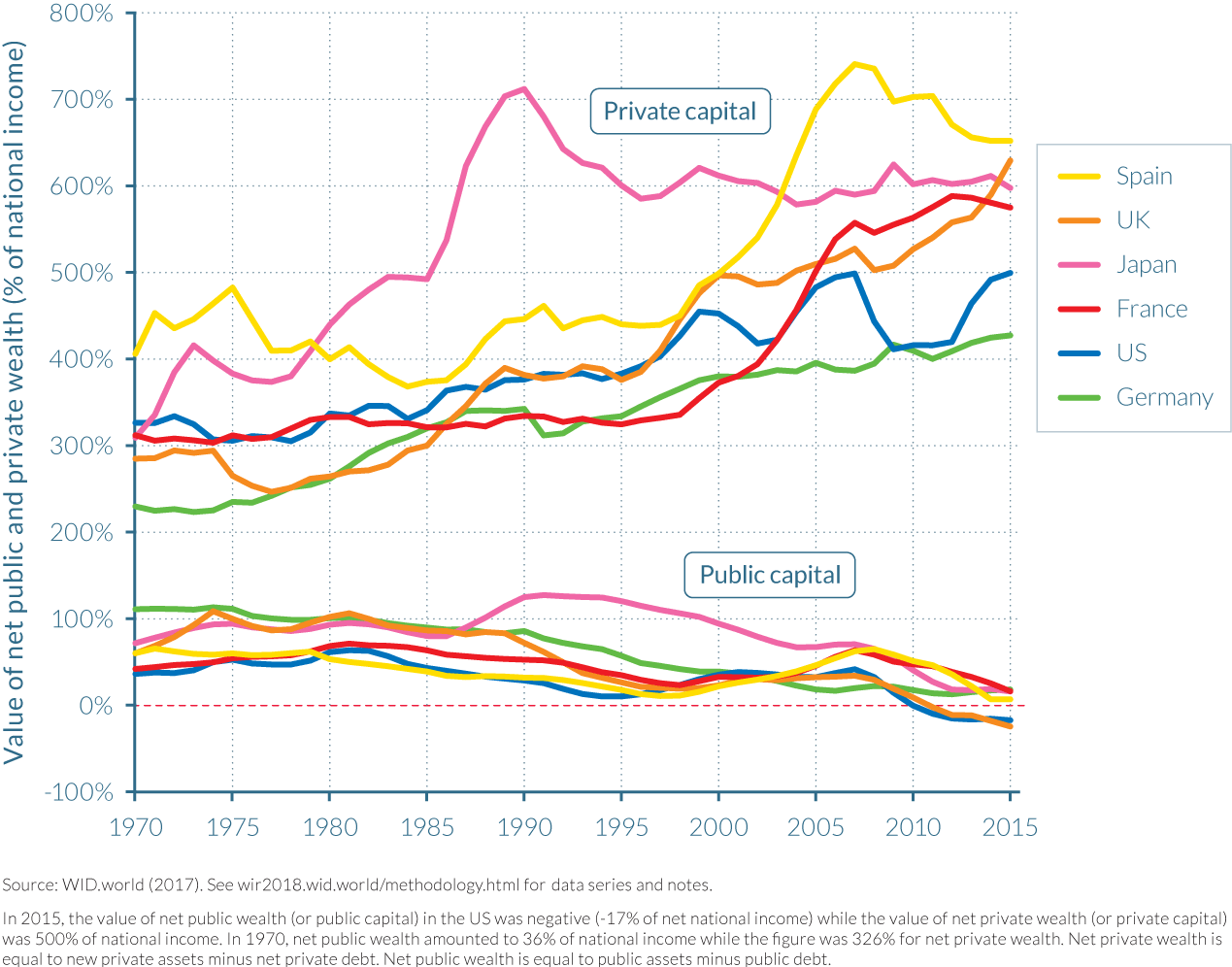
If we implement a generous basic income program, the people at the lower socioeconomic strata will likely spend all their basic income. The people who spend their newfound money will likely spend it in a similar manner to their current expenses. If the current system is set up such that that money will end up in the hands of private corporations then any new allocation of capital to citizens will just filter back to the same end beneficiaries. If basic income is funded through new taxes, then all a basic income does is increase transfers of private capital in society amongst private people. If basic income is funded through debt, then it will reduce the amount of public money in a relative sense. This is to say that if the government were to issue currency directly to citizens, it would devalue the existing currency in circulation including the capital of public corporations and thus relatively increase the importance of private capital in the overall economy.
It should be noted that capital ownership is not purely binary. So far we have discussed mostly wholly private capital or wholly public capital. This is generally the makeup of capital in the world, but there do exist hybrid models where control of capital is shared between private shareholders and public institutions. Beyond corporations with the government as an investor, there are also co-management forms of corporations. In Germany and Sweden it is required to have worker representation on the board of directors and they have an important say in how the capital and decisions of private corporations are made. This shared decision-making process, imperfect as it might be, is a form of blended capital that is neither wholly private nor wholly public. It is notable that Germany and Sweden are places where there is little advocacy for a basic income. Perhaps it is related as many basic income advocates are asking for basic income as a form of transfer of power and decision making. If you already feel like you and your brethren have control over your destiny and over decision making, you may be less likely to support the concept of basic income.
Either way we think about it basic income is helping private interests at the expense of public institutions. Ultimately a large transfer of money to citizens will reduce the power and influence of democratic government and increase the power of private interests. Since private capital as a proportion of the economy is at an all-time high since 1910, a basic income will likely only exacerbate the existing problems that are already undermining our democracy and our economies.
The fact that basic income is in fact about private capital forces us to confront important elements of such a program and address critical social questions. Should we really be reducing the weight of our public institutions? Is the government and other democratic institutions already doing too much? This is ultimately a political and philosophical debate. I firmly believe that our collective, citizen-controlled institutions, such as the government, coops and other types of governance structures can and should do much more than what they are doing today. There are obvious examples of how government could improve the balance in society. In general, I would categorize three types of potential spending we could undertake as a society:
- Improve pay of existing public servants. Instead of a basic income, we could give a raise to important government funded jobs such as – nurses, teachers, and others. This would increase their standard of living and potentially attract higher quality candidates for the positions.
- Improve quality of service for existing services. For example, we could hire more people for tasks that currently do not have enough labour – teachers, nurses, etc. Government could better enforce existing regulations with more inspectors and lawyers. Having worked in the environmental and safety compliance space, I can assure you that our environmental laws are not well enforced and that we still have dangerous products on the market, regular infringement of regulations and lots of dangerous work happening at job sites. Science and innovation are underfunded and critical social infrastructure such as parental leave and child day-care are not universally available. In short, there are many systems and programs that we could simply add resources to and benefit many people in society.
- Create new services not yet offered by society. We could decide to create entirely new services and programs that do not yet exist – creating work and improving society. This could be anything from energy efficiency retrofits of homes and buildings to construction of new schools, research centres of a manned mission to mars. Lots of things we know we could do if we wanted to, but we have simply failed to invest the resources into these potential programs.
These three categories of potential government spending, increased funding to existing programs, expansion of existing programs and new programs are all powerful ways to move society forward, create wealth and alter the balances of power. Any program needs to be well managed by competent people and that is an obvious challenge. However, history has shown that when a society is movated and the right incentives are put in place there is literally no limit to what we can achieve. The question I have come to ask myself is whether basic income is the right tool for the situation. Considering all the options discussed so far, I think we need to take a hard look at other options that will build up our shared wealth and create a brighter future. Beyond the cost of basic income programs, I believe there is a fundamental contradiction between democratically publicly controlled allocation of resources and the issuance of resources to private individuals. We need to decide if we are all in this together or if we are all in this alone.
Production problems
The Netflix Nordic satire Norsemen takes place in medieval Sweden. In the show, the local tribe of Vikings decide to exact vengeance on the nearby farming community. They massacre nearly everyone until they realize they have killed most of their farmers. The warrior tribe then realizes that it is in the business of raiding and pillaging and has little to no farming skills. Near the end of the massacre, they come to the realization they should not kill all the farmers or else they may have no food in the winter to come. They stop short of a complete massacre and let a few farmers survive so that the warriors may have some food in the seasons to come. This parody illustrates the critical element of our society – we need to produce goods and services or else we have no goods and services. This should be rather evident to all of us, but in our modern world of buying products at the click of a button and with little thought for their provenance, we often forget the underlying complexity of the societies that made the product possible. To create a computer, you need a vast human civilization with thousands of suppliers and companies all working together to produce this advanced and cheap piece of technology.
The ownership, incentives and profit sharing of these webs of companies is a fascinating subject. However, without the production by individuals and public and private corporations, our entire way of life would not be possible. It has been said that all of human history can be summarized of the wealthy trying to extract as much as they can for as little work as possible and the working class trying to work as little as possible for as much money as possible. This fundamental conflict is at the root of nearly all our debates, wars, and internecine battles. In fact, this desire to work less while also achieving greater comfort operates at the level of a country. One way for society to feel wealthier is to outsource the production of goods and services. We have done this in a substantial way in the last forty years – sending production overseas to low paid workers in developing countries. We then exchange our money for their goods and services. This of course can only last if other countries are willing to accept our pieces of paper in exchange for their labour. The current COVID crisis highlights even more our dependence on the supplies from other countries. Without the willingness of southern countries to feed northern countries in exchange for money, we would have a much blander diet. Without China’s desire for foreign currency Amazon would have a difficult time providing the abundance of products they offer. In short, our ability to exchange money for goods is a remarkable slight of hand that has allowed certain countries to achieve high standards of quality of life while producing much less than they consume.
The countries in the chart below with positive account deficits produce more than they consume and the other countries consume more than they produce. This is of course fine as long as other countries agree to keep going along and currency valuations hold over time.
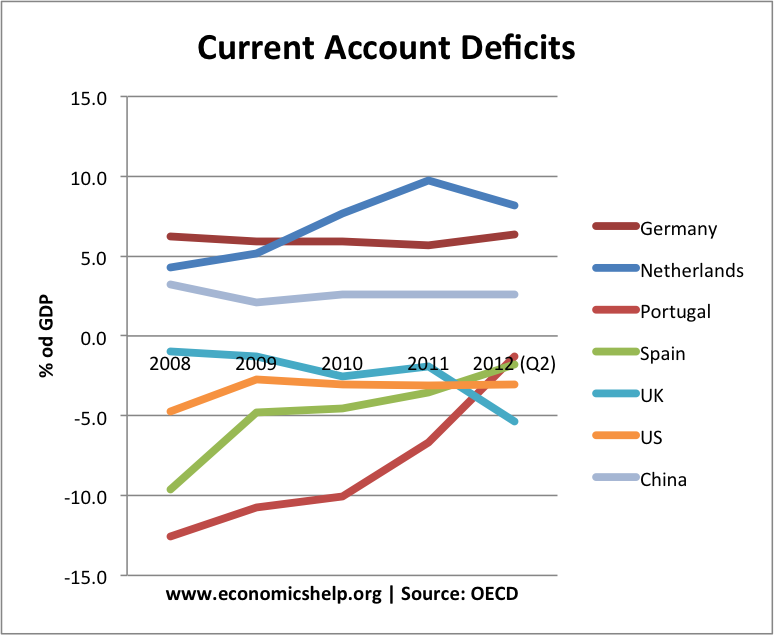
The following charts outline the outsourcing by U.S. based multinationals over the past 20 years or so. In short, more jobs are being created outside the U.S. than inside the U.S by U.S. firms. This trend can continue for a while, but it eventually catches up with us as citizens without income have less purchasing power and sentiments of resentment can build up and coalesce around authority figures who promise a return of wealth and jobs to a country’s citizens.
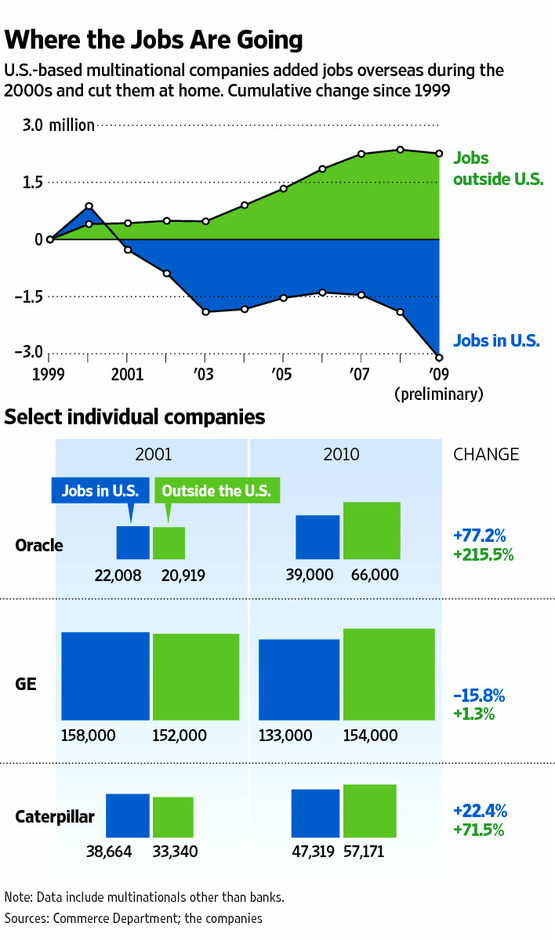
If we take outsourcing to an extreme it is called colonialism. If we take colonialism to the extreme, then you have something where the colonies have absolutely no autonomy and the people in colonies are either representatives of the mother country or they are enslaved. The closest thing to this extreme form of colonialism is probably the Spanish empire. In a very oversimplified version of history, the Spanish empire managed to live off the production of others by enslaving people, then having them mine gold and silver from their mines in South America and then exchanging these metals for goods and services produced by others. The Spaniards, having discovered vast stores of wealth in their new colonies, decided to live large and spend this on a variety of projects. While this ability to live off the work of others was certainly fun for the people on top, it created a myriad of other problems that are still being felt today in both Spain and its former colonies. In part, the wealth Spain obtained through its colonies blinded them from full participation in the industrial revolution and from investments in science, education, technology and social improvements. Once countries such as England, France, Germany and the United States had industrialized, it was nearly impossible for Spain to catch up in quality of life, productivity or social mobility for its citizens.
In a similar way to the Spaniards, European societies tried and largely succeeded to outsource some of their production through slavery and colonization. At the peak of colonialism, the colonies provided over 10% of the national income of the UK and France. The graph below shows the amount of assets in the colonies owned by the European powers. This net income from the colonies allowed for certain members of society to build vast stores of wealth and for the countries with large colonies to invest in their future through educational institutions, infrastructure and the establishment of globe spanning corporations. The jealousy of European countries for their peer’s colonial wealth was likely one of the instigators of the first world war. Countries such as the US, Canada and Australia may not have had colonies, but the counties were sufficiently vast and bountiful that in a sense they had colonies within themselves and they had sufficient room for economic expansion that no one could be bothered to colonize another country.
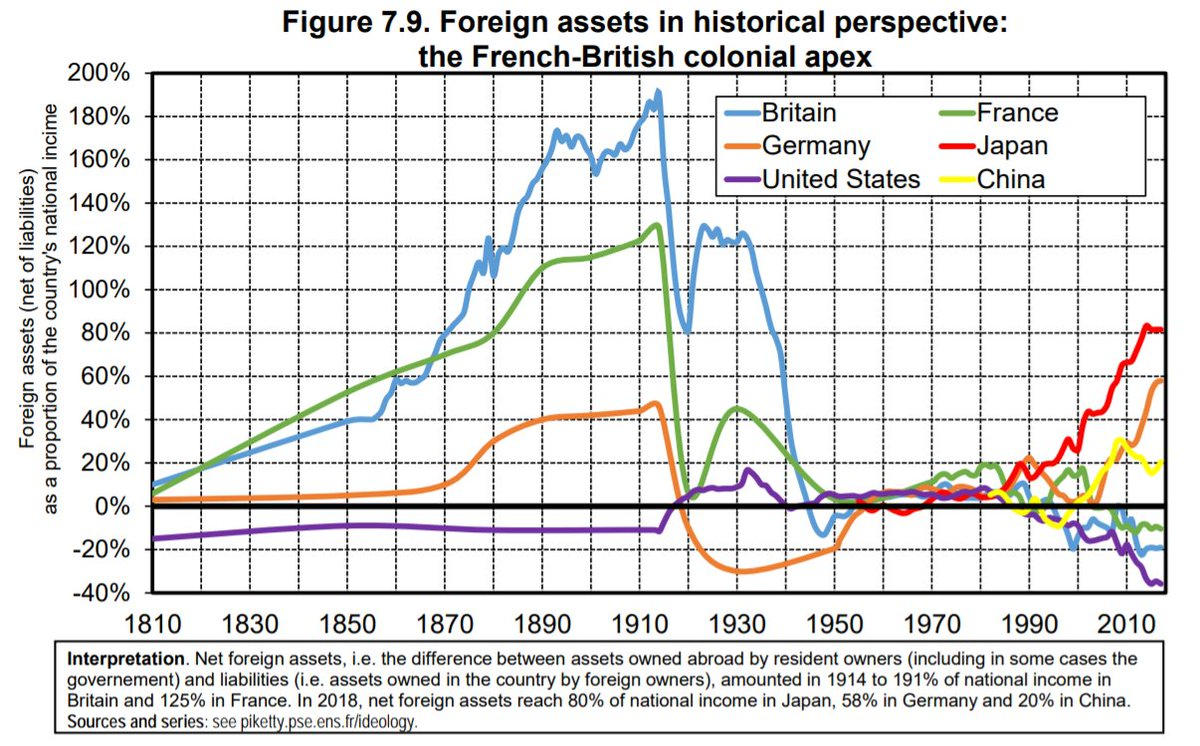
This extreme form of outsourced labour – Slavery – has always been with human society. Slavery is simply the most extreme form of our desire to live off the production of others. Many countries have used slavery as a key building material for their wealth. The use of slaves has obvious benefits to the slaveholders and obvious pain and suffering to the slaves. Beyond that, slavery also creates challenging dynamics within the society at large. When Rome brought back hundreds of thousands of slaves from its foreign wars of conquest in the 2nd century BCE it created an internal problem. So many slaves were brought back that wealthy patrician landowners no longer needed the labour of romans and romans could no longer find meaningful work. The out of work romans started to foment and demand a more equitable sharing of wealth, which led to internal battles between patrician and plebian forces and eventually led to the schism that ended the republic. Put another way, extreme inequality in Rome led to conflict which led to a form of nationalism and dictatorship. For democracy to work, there must be a substantial middle class and elites who are willing to engage in compromise – there is no other way about it.
A more contemporary example is the United States which had slavery within its own borders, and it required a bloody civil war to end the practice of slavery in its most direct forms. Slavery is present in other forms both in the United States as well as in many countries around the world. There are still forms of slavery in the US prison system and the world still has about twenty-five million indentured labourers or slaves (ILO Sources). While outsourcing to low-cost countries is not slavery, it is an attempt to achieve the same thing – production of goods and services at the lowest possible monetary cost. The freedom accorded to the slave owners is what allows them to pursue leisure and interests with little to no productive value to society. At a macro level, out outsourcing in many developed countries has allowed us to increase our quality of life substantially – just think of all the gadgets and products we use every day from China and other countries around with world with lower labour costs.
The long and arduous battle for increased quality of life and freedom for all people requires that workers obtain a fair portion of the wealth they create. If the working class and the productive part of society cannot obtain sufficient income to continuously improve their standard of living, then the system must be diagnosed as fundamentally broken. It is my firm belief that human progress is fundamentally intertwined with increasing the rights and freedoms of workers so that they cannot be put into precarious situations by powerful interests. This is the same battle mentioned above – workers want to work as little for as much as possible. In a sense, Germany has been the best example of this balance with decreasing amounts of hours worked while simultaneously increasing productivity and production.
Today we can purchase cheap clothing (and many other things) partly because we have very low-cost labour in developing countries. We also have many products that are made cheaply thanks to advances in technology (i.e. automation) and organizational systems (i.e. lean manufacturing). As a society, we of course want to foster the production of goods and services with as little inputs as possible – but this needs to be achieved through technological advances and not through a long-term reliance low-cost and precarious labour. Industries that still rely on cheap labour need to be addressed in a systematic way. Basic income would help certain workers demand higher pay, but it would likely also create a demand for low-cost products made overseas where basic income is not available. In a sense, we would simply be transferring the suffering of our working class unto the suffering of another country’s working class. Our long-term solution to production of goods and services cannot be the outsourcing of labour. We must strive to improve our own production while also improving worker rights and our public infrastructure.
If we can agree that outsourcing too much labour is not a long-term solution to our production problems, then we are recognizing that we need to maintain and improve our own productive capacity. To produce goods and services we require a few core elements such as rule of law, investment and most critically, the opportunity to generate returns. We need to have consumers who have the ability and desire to purchase our goods and services. In this regard basic income would help as most members of society would be able to purchase more. However, many of the purchases that people wish to make are for products that are currently produced outside of our borders. The goods and services most desired by our fellow citizens are in fact items like food, cars, clothing and electronics – much of which are produced outside the borders of developed countries. The main domestically produced item that basic income would likely support is housing – renovations, and upgrades to housing. If this is true that a substantial portion of any additional spending power will go to purchase products that are not produced domestically then a basic income may be one of the largest transfers of national wealth to foreign countries. Before we increase our average purchasing power through a basic income, we should take a careful look at what will be purchased. If the money is simply sent overseas with a cut for the corporate middleman, then society will not be any better off. In fact, a basic income could accelerate outsourcing as companies seek to capitalize on increased buying power from the lower socioeconomic part of society that is searching for low-cost goods that, currently, cannot be produced in the same country they live in.
For us to increase the productive capacity of the country we need an organizing force that will drive innovation and technology development. We cannot rely solely on consumption as there are already competing forces in the market that will not allow for consumption to be the main driver of innovation. To take a recent example of excellent government action that led to amazing innovations we can look to the United States and the tax credits for electric cars or the NASA contracts for launch capacity to the International Space Station. The objective of both these programs was to provide innovative companies with a financial runway to build up enterprises that are sufficiently large and robust enough to compete at an international level.
From Wikipedia:
In 2006, NASA announced that SpaceX had won a NASA Commercial Orbital Transportation Services (COTS) Phase 1 contract to demonstrate cargo delivery to the ISS, with a possible contract option for crew transport.[212][213] This contract, designed by NASA to provide “seed money” through Space Act Agreements for developing new capabilities, NASA paid SpaceX $396 million to develop the cargo configuration of the Dragon spacecraft, while SpaceX self-invested more than $500 million to develop the Falcon 9 launch vehicle.[214] These Space Act Agreements have been shown to have saved NASA millions of dollars in development costs, making rocket development ~4–10 times cheaper than if produced by NASA alone.[103]
In December 2010, the launch of the COTS Demo Flight 1 mission, SpaceX became the first private company to successfully launch, orbit and recover a spacecraft.[215] Dragon was successfully deployed into orbit, circled the Earth twice, and then made a controlled re-entry burn for a splashdown in the Pacific Ocean. With Dragon’s safe recovery, SpaceX became the first private company to launch, orbit, and recover a spacecraft; prior to this mission, only government agencies had been able to recover orbital spacecraft.
COTS Demo Flight 2 launched in May 2012, in which Dragon successfully berthed with the ISS, marking the first time that a private spacecraft had accomplished this feat[216][217]
NASA went on to award further contracts to SpaceX that have continued its growth. However, these initial contracts were essential to getting SpaceX off the ground. Beyond the initial prize the real key to building up an industry is the consumer demand for the product or service being produced. NASA and many other companies had a need for lower cost satellite launch capacity and thus SpaceX has been able to thrive. In contrast to this, a basic income would not incentivize the creation of new services – it would like accentuate demand for existing services.
Similarly, Tesla and other electric auto manufacturers benefited from Department of Energy funding to get them started and they still benefit from tax credits related to zero emission vehicles and carbon caps. However, even prior to these funding opportunities through taxes and government programs, Tesla had already raised approximatively 75 million dollars and produced the expensive and limited Roadster. Afterwards, “In January 2010 Tesla received a $465 million loan from the U.S. Department of Energy, which it repaid in 2013.[29]”
Again, the point here is that loan was critical to the development of Tesla and for its ability scale up production to create a more affordable vehicle the Model S and then the Model X. But there was already an initial unserved demand for fast, performance and luxurious electric vehicles. With the government funding and private funding Tesla was able to scale up production capacity and eventually achieve production of 500,000 vehicles, many of which are the more affordable Model 3 priced at $45,000. Once that had been done and profitability was demonstrated, Tesla had achieved escape velocity and could continue to grow through the traditional consumer markets.
The main point is that to create innovation, government must take an active role and provide critical seed funding and incentives to invest in complex technology that moves society forward. However, government industrial incentives must target industries, product and services for which there is an unmet demand. If there is no consumer demand, then you are likely wasting your money. Beyond the simplistic measure of unmet demand, we should further refine our criteria to focus on higher value and sustainable products. Our objective as a society is not to simply produce more goods and services, but rather to produce more value with less impact on the environment.
Goods and their production requirements run the gamut from simple products to highly complex products that require many complex suppliers. Simple products such as textiles have simple supply chains and rely on low skilled labour. These products thrive in countries with low labour costs and that is why few textiles are produced in developed countries. These Industries are also easy to move as there is a simple supply chain (cotton, wool, nylon,…) and limited machinery (looms, sewing and dying equipment). Complex products, such as cars, planes or computers have much more complex supply chains and require high skilled labour. These industries are harder to move and once they do relocate, they end up migrating their supply chains as well. Once the supply chains and all the companies have shifted to a new region, it becomes exceedingly difficult if not impossible to bring them back. One reason why the US Military builds a new nuclear powered aircraft carrier every five years is to simply ensure that the suppliers and technology are always ready to produce military goods regardless of if there is any immediate need for these goods. Maintenance of production capacity is important when it comes to national defence. The crisis to produce covid related supplies was a point in case of the need for maintaining local production of vaccines and personal protective equipment.
Many western countries created important scientific and production advantages that they are still relying on. The industrial revolution and then the two world wars allowed European powers to get a substantial economic head start compared to other nations. This advantage has meant that many complex industries such as aviation, car manufacturing, and electronic component design are still located in OECD developed countries, but we have seen this erode every year as countries such as China and India catch up in skill and sophistication. The reason for the erosion of the control of high-tech industries is not due to labour costs, but rather due to the development in knowledge of workers in low-cost countries and information technology systems that allow for low cost and real time communication. Globalization of production is a fascinating topic and is well documented in the book, “The Great Convergence”. The increased revenues generated by local production of higher value goods and services has created a growing consumer base in many previously underdeveloped countries. These are all good things and should be encouraged as they have dramatically increased the quality of life of billions of people. However, if developed countries wish to maintain their position at the top of the pyramid of nations – they need to find a way to create more and more value for their citizens while competing in an international market. Ultimately all countries must continuously innovate and grow or else there will be structural problems that monetary policy alone cannot resolve.
For a medium size country, such as Canada, to compete at an international level the government will need to make large scale investments that allow us to build up enterprises with some form of competitive advantage. We need to encourage entrepreneurship and risk taking but we also need to protect certain industries and invest in the surrounding infrastructure. Entrepreneurship alone is not enough. While basic income may incite some to take a plunge into a new venture and try to build a company, basic income will not contribute all the other parts that are required for successful business ventures – consumers, capital, qualified labour, etc. It is a very difficult challenge to increase the wealth of a society in a competitive global market and the failure of many governments to achieve greater wealth for the average citizen in the past 20 years is part of the reason certain countries are attempting to reduce international competition through tariffs and isolation. The rise of nationalism in the forms of Brexit, Trump, Orban, Bolsanaro, Modhi and others are highly linked to the erosion of the middle class. Beyond the simple monetary and purchasing power erosion of the middle class of developed countries there is an important emotional element to the loss of national prestige and hope for the future promised by traditional liberal policies. The excellent movie “American Factory” outlines the human tole when a unionized car factory closes and is replaced by a Chinese owned facility that pays $16 an hour instead of the previous owners, who paid $45 an hour. The emotional devastation wrought on the people and the community is huge. One attempt to counter this trend is to close borders and add tariffs in the hope of protecting workers and industries. These nationalistic governments are trying to protect domestic industry from a highly competitive market where other countries either have technological advantages or economies of scale or both.
Oddly enough, China has been the most recent (and successful) example of using protectionism to build domestic industries and it is only when they feel these industries are sufficiently competitive that they allow foreign entrants into the market. China has and continues to protect a variety of domestic industries while relying on an export driven economy that is dependent on European and US Consumers. This is changing on both sides as some countries are increasing taxes on Chinese products and China itself is attempting to decouple from high tech suppliers through its Made in China 2025 program. Despite a large manufacturing industry, China is still dependant on key US and European suppliers for many critical products. They are trying to break this link and once they do it will be challenging for those countries to catch up. One small and banal example is the fact that China only recently produced a ball point pen from scratch.
The same strategy of protecting domestic industry until it is mature enough to compete was employed by European countries and the US as well during their development in the 18th and 19th centuries. There is tremendous research on the topic of economic development, trade and competitivity of industries and I think we need to carefully reflect on what additional consumer revenues will be used for before we send basic income cheques to everyone.
In summary, it seems clear to me now that a basic income funded through debt will not make our economy more competitive – it will only accelerate existing trends in society. A basic income funded through taxes may have more benefits by levelling the playing field but implementing such a basic income is a political minefield that is unlikely to be navigable. With the current structure of our economy, a basic income will transfer more wealth overseas through our purchases of foreign produced goods and the owners of the importing and manufacturing (i.e. owners of the means or production) will be the ultimate beneficiaries of a basic income. If we want to spend billions and billions of dollars, we should invest in large scale public enterprises and high value domestic production that serves an unmet consumer need. A basic income will reinforce our bad habits and ultimately lead to inflation and a slowdown of innovation and productive capacity. Only the government with its ability to print money and aim for long term can kick start a process of economic development that will increase our output and generate innovative products and companies.
Creating purpose
At an individual level, the links between employment and happiness are quite clear – study after study shows that having meaningful work with good working conditions is the foundation of a happy life. As a society we need to work harder to put in place programs that will create productive work in well paid environments that will push society towards sustainability and economic growth. As far as I can tell this cannot be done with basic income and basic income may even hinder this effort.
Humans are both astonishingly complex and also remarkably simple. Each person is unique and special, but we all share certain common attributes that make us fundamentally human. I firmly believe that a core element of human happiness is purpose. To be happy we must feel that we have a purpose in life and that we are contributing to something larger than ourselves. The most unhappy people are often those without purpose. It is critical to note that we are just as capable of having a good and productive purpose as a negative and destructive one. The Nazi party members of Germany had a clear purpose. Catholic missionaries have a clear purpose. A purpose is core to identity and to our sense of belonging to a cause larger than ourselves – that cause need not be positive or progressive. One of the key elements is community cohesion, by sharing a set of values and a core goal we can form a group. Belonging to a group is absolutely fundamental to the human psyche and is deeply ingrained in our evolutionary brains. We can also have smaller scale purposes. For many, our purpose is to raise our children to be healthy and happy adults and to continue our family line. This purpose of childrearing is the one most anchored in our biological brain – without our own children, our genes die off and without any children, society dies off. The purpose of raising a family brings tremendous happiness to many people on our planet. The point is that we all need purpose – good or bad, big or small – we need something to work towards.
The incoherence discussed in the first part this essay undermines the ability for people to form a group identity around basic income. There is a lively and dynamic basic income community, but its lack of a larger philosophical structure is impeding its growth and stability. There are some basic income advocates who believe their core purpose is to promote basic income, but despite their best efforts the movement does not seem to be growing in size or power. This lack of growth suggests there is something amiss in the group identity. Where there is a lack of clarity of purpose you inevitably see lackluster support and growth.
We can now turn to the question of whether a basic income itself would provide purpose to people or provide the means to pursue their true purpose. Basic income advocates often explain that a basic income will empower people to seek and work on their core desires. An artist who had to compromise and work 9-5 at an office will now be free to focus on their purpose – art. A young person who dropped out of school because of financial reasons will now be able to continue their education and eventually pursue their true calling in life. We all make compromises in life for a variety of reasons, a basic income would undoubtedly help people reduce the number of compromises they make. This may indeed allow more people to seek their true purpose and have the courage to take the necessary steps in that direction. In my opinion, this is one of the most powerful arguments for UBI – it will allow all of us to find our true purpose in life.
I still see significant challenges in using basic income as our primary tool to allow people to find purpose. From what I can tell, the challenge in using UBI as our main tool to empower people is that it is still lacking certain key elements. Most of us find our professional purpose through large organizations – be they private or public. Very few people have any desire to start their own business or be their own boss. Online self-training has limited reach and people still prefer a structured environment of schools, colleges and universities. A UBI is unlikely to create many new entrepreneurs though it may encourage a few people to pursue a project they had in mind. To offer purpose to the bulk of the population, we need to build and maintain these larger institutions to offer purpose to people who seek it. These large institutions form in and of themselves part of a cultural identity that helps people adhere to a national image – think of the army, large scale public corporations or large infrastructure projects. These types of organizations offer employment to people and purpose to their staff while also creating identity and cohesion for the nation. The progress of humanity is heavily dependent on inspiring people. We need to inspire people and that requires many people to work together on ambitious projects much larger than themselves.
There is the famous story of a visit to the NASA space centre in 1962 by President John F. Kennedy noticed a janitor carrying a broom. He interrupted his tour, walked over to the man and said, “Hi, I’m Jack Kennedy. What are you doing?” “Well, Mr. President,” the janitor responded, “I’m helping put a man on the moon.”
True or not, this story explains how people can find purpose beyond their individual work. We are able to see well past ourselves and understand that we are part of a larger project no matter how small our task might be. The space program was one of the grandest and most expensive projects in US history. It has since sadly been underfunded since the accomplishments of the 1960s. Grand programs like this require vast amounts of money and resources. If done properly, they provide technological discoveries and inventions that benefit us. There is a long list of NASA spinoffs that you can see every year. Great achievements can only be made by groups of people working together under pressure. Adversity is a key ingredient of group cohesion and happiness – why else would we do some of the crazy stuff humans do. Society needs to create these conditions and direct our resources towards challenges that will help solve problems of importance.
In conclusion, I think the decision about basic income comes back to our assumptions. What is the best way to solve poverty? What is the best way to give people purpose? How do we give people freedom to pursue their ambitions? These fundamental questions can be twisted and turned in a myriad of different ways that would fill bookshelves. But, boil it all down to its essence and I think we have a fundamental choice to make. Do we invest in technology, science and automation and create large social projects or do we simply distribute money to people because we lack better ideas?
No one claims that providing a basic income will somehow magically create large institutions and create innovation. However, it seems obvious to me that in many ways a basic income is contradictory to the approach of building large projects together. Basic income is individual in its very nature – the money goes to a single person. Basic income also sends a message that our individual decision making is better than our collective decision making. This may be true in some situations, but I have come to the conclusion that democratically made decisions with the help of strong leaders is the best way to help society progress and provide purpose to people.
Freedom
The word Freedom is open to a great deal of interpretation. I think it is critical to define two key types of freedom – individual freedom and group freedom. Historically we thought of the word freedom as a group of people who controlled their own destiny. We can think of the groups of oppressed peoples who sought freedom through battle, ballots and emigration. Myself, as a person of Jewish and French Brittany descent, think of the battles my ancestors fought and lost for their group of people to speak their language and practice their religion. This is typically how freedom was viewed – a battle to deceit the fate of their own group of people. In the past fifty years or so freedom has come to mean something entirely different. Most of us now think of freedom as individual freedom. We want to be free to do the things we want, buy the things we want, travel the way we want. We want to be free from taxes, free from cultural oppression and free from anything we do not agree with. This understanding of freedom is intrinsically tied to the rise of consumerism and capitalism. The excellent documentary, Century of the Self, outlines how this concept of freedom was built throughout the 20th century. Basic income is primarily about individual freedom.
One of the main points that basic income advocates will make is that a basic income provides freedom. With UBI you will be free from poverty, free from the paternalistic state, free from your lousy job, free to do what you want. In fact, the freedom argument is the most powerful one I have found and one of the arguments that I use the most often in favour of basic income. However, I am starting to think that basic income may not even be the best way to provide freedom. As outlined above, I think that a basic income would in all likelihood reinforce the existing consumer culture we have and not help us transition to a more sustainable or a society with more solidarity. Basic income will accelerate existing tendencies in society and I think we can all agree that there is a strong tendency for us to buy low cost items from large corporations who pay little taxes. Amazon is doing pretty well these days and there is a good chance a basic income would just help them further (at least on the consumer side). Freedom must go beyond purchasing power. We need to propose greater freedom to people that is not just based on financial freedom, we need to offer true freedom for the person as a whole.
True freedom requires not just financial means, but also education and growth. To be free you must not just free your body from bondage, you must also free your mind from the shackles of your environment. Free and widespread liberal education has undoubtedly been one of the greatest providers of freedom on the planet. But even with strong education, you are in no way guaranteed to be free from poverty or oppression. It was well known that the USSR was the only country where you could hire a cleaning lady with a PhD. To create true freedom, you need much more than education, but it is a key building block. Society needs to provide lifelong education along with employment opportunities that offer growth and that create that larger social objective discussed above. We need to provide tools and resources to people while also offering avenues and environments where people can deploy their skills to good use.
To find and pursue your purpose requires freedom. If you do not have freedom you are unlikely to find your purpose in life. It seems unlikely that slaves in the 19th century thought their purpose was picking cotton for wealthy landowners. Freedom can be provided in a few fundamental ways. Franklin Delanour Roosevelt proposed four key freedoms, “Freedom of speech. Freedom of worship. Freedom from want. Freedom from fear.” Without diving into each of these freedoms we should ask ourselves how does a basic income help? Freedom of speech and freedom of worship seem unlikely to be greatly affected by basic income. Freedom from want and freedom from fear would certainly be advanced by a basic income.
With a financial floor under your feet you would have less stress and anxiety about paying the bills. A basic income would reduce the fear of quitting your job or starting a business. For those less fortunate, basic income would eliminate the fear of abject poverty – lack of food and shelter. It would also help women (mostly) leave abusive relationships and eliminate the fear of a violent partner from their lives. Basic income does not really address other types of fear – political, social or discriminatory. There is no reason why we could not have a basic income in a totalitarian state. There seems little doubt that a basic income would reduce fear in society and that is certainly a good thing.
In terms of freedom from want, I am skeptical that basic income is the right solution. Of course a basic income would allow for people to purchase more goods and services and reduce their “want”. This would give everyone that monthly top up to buy the things they need or want, but it does not address the production side of the equation. As discussed above we need to both produce and consume. Without stuff, there is no stuff. The ability to produce goods and services is a form of freedom. A society who is dependent on imports for its survival is certainly not free. In some aspects, freedom requires autonomy. No person can be fully autonomous, but a society needs to have the means to be fairly autonomous and produce at least enough to thrive and to trade with other societies for the items it wants. A basic income would just encourage us to import more products and services and I fail to see how it would assist in the production side of the equation. If anything there is a risk that basic income makes us more dependent on other societies and perhaps ultimately reduces our collective freedom.
For all the warts of the current capitalist economic system, it has worked fairly well. In developed countries no one is starving, no one lacks clothing, no one is living in mud huts anymore and in general, people no longer die due to lack of medical care. One of the best ways to determine what works at a large social level is to compare countries who started in similar places and where they are now. China is perhaps the most powerful example of the ability to grow a country. China has gone from a very, very poor country to an advanced technological society in about 70 years. The economic growth achieved in China has never been achieved by any other country in the history of the world. Having lived and worked in China I can assuredly say that no one wants to go back to the 1950s when China was poor, dependent and definitely not free. Humanity has concretely and unquestionably made tremendous progress in the past three centuries. My main point is that freedom from want and fear is mostly dependent on our technological progress. Technology goes beyond physical inventions and includes changes to social structures, innovation in organizations and methods for mobilizing people. To achieve greater freedom for both individuals and groups of people we need to invest in large social projects, not simply distribute money to individuals.
In the past three hundred years, through toil and pain, we have made unimaginable technological progress. Our progress in transportation (trains, cars, planes) has freed us to travel at our leisure. Our progress in home appliances (washing machines, refrigerators, air conditioners) has freed us for other tasks and improved our health. Our progress in communication (telephone, internet) has allowed us to communicate freely. Our progress in medicine (antibiotics, surgery, diagnostics) has freed us to live longer and healthier. The list goes on. In short it is our technological progress driven mostly by large scale government investment that has pushed human civilization forward. The famed and late statistician Hans Rosling gave an excellent TED talk on the power of technology to free us from bondage. It is technology and not money that pushes us forward. Any large scale government spending should be spent on science and technology to help push us forward.
For nearly all of human history there was little to no technological progress. We must not take this progress for granted. Over the millennia of human history, there were spurts of growth and progress in various parts of the world. Ancient Summaria saw the creation of money and modern society, Egypt brought us large scale infrastructure, China developed paper, gunpowder and the printing press, we obtained democracy from ancient Greece and the Islamic made significant mathematical advances. Despite these various innovations human civilization was fairly stagnant for nearly all of its history. We lived in a world that was structured and ordered, but ultimately at the whim of the local elite, a plague or a powerful warlord. Life was short and brutal with no hope for change.
It was ultimately in Europe and only in the late 15th century that we created enough innovation to start the revolution we still live in. The innovations in religious reform, science and economics created a breach in the darkness and oppression imposed by aristocracy and religion. For thousands of years, the church and the elites told the population that the world they inhabited was good enough. They let the people know that what they had was all they should expect. They refused to apply taxes or develop government services. They killed and imprisoned anyone who dared speak out against this oppression. It took the sacrifices and bravery of scientists, tinkerers and politicians to upset the system – freeing us to expand onto our current trajectory of growth and innovation.
In light of history how should we proceed? If our objective is to achieve greater freedom should we pursue a basic income or something else? Do we think we have attained a sufficient level of progress that we should now focus on sustainability and leisure or is there much more for us to do? These fundamental questions underpin our decision about basic income. My firm belief is that we must prioritize group freedom above all else. We need to build societies that are innovative, progressive and offer purpose to the most people possible. This requires individual freedom as well. No state can be all seeing. If we can offer individual political and economic freedom to citizens and then create large public projects to channel their talents, there is no limit to what humanity can achieve. We must seek freedom for all and that requires us to focus on collective projects. Basic income at a large level would prevent us from building many of these large projects and would send a message that individual freedom is more important than our collective freedom. Instead of fighting for basic income, we must fight for a vision of the future that inspires us to wake up in the morning and work hard with a group of our fellow citizens for a better future.
Inequality
Nearly all sane people agree that the current levels of inequality in society are not desirable. Study after study shows that inequality is rising and has nefarious implications for social order and the economy. Thomas Picketty is the author of Capital in the 21st Century and Capital and Ideology which are recognized as the references on the history of inequality in society. He has spent his entire life studying inequality in society and how it affects nations. The combined 2,000 pages of his two main books paint a bleak picture. Human society has always been deeply unequal and the only thing that ever reduced that inequality was large scale war. Surprisingly, even revolutions had limited impacts on inequality. Nevertheless Picketty is the first to admit that we must reduce inequality if we want to achieve any semblance of justice and progress for our fellow citizens.
It is interesting to note that Picketty is not particularly in favour of a basic income. The main proposal in his books is a wealth tax and an allocation of capital to everyone. What Piketty deftly outlines through his research is that we should not focus on income as much as we should focus on capital. It is inequality of capital that is the real underlying problem – not income inequality. That is why he proposes to impose a wealth tax on those who have a lot of capital and then to issue new capital to all citizens as a one time transfer. This one time transfer would allow citizens to have a certain independence and it would dramatically decrease inequality in society. In a certain way, this approach has already been taken by China and explains part of their rise. As I explained a few months ago China issued large amounts of capital to private enterprises, state owned enterprises and to its citizens.
One of the first industries China tried to reform and make profit driven was the textile industry. To do this, Deng Xiaoping issued large amounts of capital to a variety of state, semi-state and private enterprises that allowed them to buy looms and machinery from overseas. He also pushed for these companies to make synthetic textiles as cotton was not produced in China at the time and they did not have the capital to import sufficient foreign cotton. The issuance of large amounts of capital or the printing of money allowed for the build up of productive capacity and the generation of profits that could be invested in further industrialization.
The second massive capital allocation to private individuals was the transfer of residential property from the state to the individual. This is well outlined by China Skinny (a weekly newsletter on economic trends in China)
China’s 2019 GDP per capita of $10,098 pales in comparison to the $65,111 in the US. Similarly, its average 2018 urban wages of around $12,000 are just a fraction of the $63,093 earned a year in the States. So why are so many brands banking on China’s structurally low GDP per capita and poorly-paid consumers to lead the global recovery? If we look under the hood, the economic metrics and drivers in China are unlike those in the West, and only paint part of the picture.
For the average consumer in China, the wages one earns influences spending less than it does in most other countries, simply because they have more wealth behind them. In fact, China’s median urban household net worth stood at $198,330 at the end of 2019, versus an estimated $104,000 in the US.
Many readers are likely to be scratching their heads wondering how they can be wealthier based on the GDP and income fundamentals above. Chinese may be known as strong savers (although the youth have been taking on consumer debt like no tomorrow over the past few years), but how could saving that relatively low income create a level of wealth double that of half of American households?
The main reason is property wealth. When China’s housing stock was privatised in the late 1990s, most Chinese families were able to buy their homes and apartments at rates that are a fraction of what they are today. As a result, 96% of urban Chinese own property versus just 64% in the US. Having bought their property for such a low price, their indebtedness is also much lower. 57% of Chinese households ‘officially’ have debt, versus 77% of American households. And Chinese ‘official’ debts account for just 16% of their assets, versus 36% in the US.
A whopping 31% of Chinese households own two apartments and 11% have three or more. When the average apartment costs over $1 million in many districts in Shanghai, for example, it means that there are a large number of very wealthy people in China who are fuelling everything from the global luxury market, to cosmetics, to cars, to milk.
Although consumers are not yet skipping through the shopping isles filling their carts with glee, the overall return to normalcy continues to track well based on spending trajectories. Chinese remain fundamentally wealthy. Parents continue to support their millennial offspring’s consumption habits in and many categories are seeing solid growth. With China’s $205 billion post-COVID fiscal spending focused on economy-building new industries such as technology, mass transport and power infrastructure, the wealth of the country as a whole is likely to continue to grow strongly over the long run, and with it, its importance as a consumer market.
Your perspective on the future is very different when you own capital or own your home (a form of capital). Though the Chinese government sold these state assets to citizens, they did so at a reduced rate with no attempt to profit or even make it financially sustainable for the government. However, the benefits of creating a capital owning class vastly outweigh the costs. The Chinese government understands deeply that no economy can be solely based on physical property and this is why China is putting all of its efforts behind the creation of growth engines based on technology. Their five year and 20 year plans for various industries put priorities on AI, infrastructure and sustainability. Put in another way, their efforts are focused entirely on creating higher levels of productivity on the back of a capital foundation.
China also has inequality problems, but their allocation of capital was critical to escaping the poverty the nation was in for hundreds of years. If we want to tackle inequality in our modern day societies we could start with education debt forgiveness, lowering tuition rates, and offering low cost housing. This would free people from financial burdens that reduce their net capital. We could also go a step further and actually issue money to individuals in one time lump sum, as Piketty proposes. This would give them a financial capital to build up their life.
In short, Picketty and I agree that the real solution to our problems of inequality is not a basic income. To really make a dent in inequality we need something much more ambitious than a basic income. We need changes to the tax code, access to education, housing prices, government spending on science and technology, and increased negotiation power for workers. While a basic income would help achieve some of these objectives it is a very incomplete solution that will create many other problems and accelerate certain negative tendencies in society. Our problems and challenges are mutli-faceted and as such we need a more sophisticated approach to inequality than simply topping up people’s monthly income.
Applying Simple Solutions to Complex Problems
One of the most attractive elements of basic income is its simplicity. For many basic income advocates, the initial attraction to basic income is often the revelation that we could solve poverty by handing out money. This apparent simplicity seems like an elegant solution to complex problems that are currently addressed imperfectly by a myriad of inadequate social programs. To many, a basic income could act as a powerful force against inequality by taxing the rich and distributing it directly to citizens without the bureaucratic overhead. The hard reality of a basic income is that it is neither simple nor easy. As discussed above, once you get into the weeds of how a basic income works, how it is funded and how it gets through the political gauntlet you realize that it is no simpler than adding new social assistance programs or reforming the programs we have. After seven years of basic income advocacy I have come to the conclusion that its simplicity is a chimera. That is to say, the more we “approach” a basic income the more elusive it becomes. For many in the movement we believed that universal basic income was a real possibility during the COVID economic crisis. However, what we are seeing is that governments are unwilling to commit to a long term direct cash transfer and asset price inflation is a very real thing when you create this much new money.
To illustrate further how little motivation there is for basic income as a structural change in society, we can look to the reception of the economic report created by UBI Works – a Canadian group that I am part of. This group commissioned a full economic analysis and simulation of basic income in the Canadian economy. The report showed a variety of impacts and ways to pay for the basic income. Despite good public relations and distribution to politicians and think tanks, it received very little reception and has had no perceptible impact. My analysis of the issue of this report and of economic modelling in general are documented in this separate article (here). People operate within frameworks and basic income as it stands today cannot exist in our economic framework. Because of its incompatibility with our way of thinking any documentation or information about basic income receives some curiosity, but fails to change any real perceptions.
As discussed in this text, the distribution of money to citizens only helps with the consumption part of the problem and not the production side. In addition, a basic income creates a series of other problems. The hard reality that we must face is that society is complex and requires complex solutions. Therefore, it is only in complex solutions that we will find the solutions to our complex problems. That complexity may be hidden in the bowels of a system but it will be a requirement if we hope to address the complex issues in society that are inevitably multi-faceted.
As outlined in a paper, “Complex systems are highly composite ones, built up from very large numbers of mutually interacting subunits (that are often composites themselves) whose repeated interactions result in rich, collective behaviour that feeds back into the behaviour of the individual parts. Chaotic systems can have very few interacting subunits, but they interact in such a way as to produce very intricate dynamics.” Human society is certainly a complex system as it is composed of people (who are composed of thoughts, emotions and issues), groups of people (families, nations, identities) who form larger groups (nations, religion, cultural) and all interact in a messy and dynamic situation. Basic income will create impacts at all levels of human society in highly unpredictable ways.
My wife is a tax lawyer and she will be the first to tell you that the tax system is complex. At first blush I always thought that there should be a way to simplify our tax system. I am not alone, this has been a recurring discussion since the inception of the modern welfare state. Even back in the 1960s, chapter three of the business book Adventures in Business outlines the desire and the folly of reforming the US tax system. As long as there have been taxes, there have been people who think we can simplify and streamline them. However, when you dive into the details of the tax code you quickly realize how unlikely a radical overhaul really is. Discussing the intricacies of the tax system with my wife has allowed me to understand that there are often good and valid reasons for a lot of the tax nuances we have. These nuances are only apparent upon closer study of the way something came about, the context in which it was implemented and the current reality of the system. The tax code does not operate in a political or social vacuum. If anything represents the complexity of human society it is the complexity of the tax code! Society is complex and requires sophisticated programs to address our problems. Just as we cannot and will not simplify the tax system, basic income is not a simple answer to a complex problem.
A similar analogy is the world of physics. Scientists have long sought out a grand theory that brings together all the disparate laws and principles of physics. It remains possible that there is some grand theory, but it is also possible and likely that the universe is just made up of many different laws and principles that act together to create the phenomenon we observe. Sometimes things are just complicated and there is nothing you can do about it except chip away at the system one discovery at a time. It is hard work to go at a problem by bits and pieces and try to identify one small part of the solution at a time, but this is basically how humanity has progressed. It is just one small achievement after another that can eventually lead to massive improvements in science, technology and social structure.
Our modern day society has a number of clear and glaring problems – affordable housing, inequality (in income and wealth), education, healthcare, poverty, environmental sustainability and other issues. At a surface level we often think that the main problem is simply one of money or the allocation of resources. But, as you dive into the details of each problem it becomes clear that money is often a symptom and not the root cause of the problem. We cannot solve most of our problems with basic income and I think that even if we somehow did manage to implement basic income, it would only be a temporary solution before the system adjusted to the infusion of cash and the same problems reared their heads.
Inflation is notoriously difficult to predict and manage. Economists have been attempting to create more inflation for the past twenty years and have generally failed. The reasons for the lack of inflation are multiple (as you would expect in a complex system). They likely include international trade, the competitive platform that is the internet, lack of strong unions and an attainment of a certain quality of life that is deemed sufficient by many people. With the current massive influx of new money from covid programs we are starting to see substantial inflation in asset prices. We have not yet seen much inflation (as of April 2021) in consumer prices, but that is likely due to the fact that foreign exchange rates have not moved much (yet) and that all countries are printing money. We have seen substantial inflation in asset prices in both the stock market (which is at record highs) and the housing market (which is also at record high). The access to cheap capital and a sense that the good times can never end is leading people to paying more for the same stock or house. This only widens inequality in society and is certainly not good, it is however a consequence of a form of basic income that is currently being issued by governments to people (and companies) that are affected by COVID. It cannot continue at this pace without inflation leaching over into consumer prices. The biggest impact will be if the exchange rate with the Chinese Yuan moves. A substantial shift in that exchange rate would lead to large price increases in many of the products we use daily. Only time will tell and I dare not make any predictions on general inflation as smarter people than I have failed repeatedly to do just that.
Political viability
The last element of my change of heart on basic income is the realization that the political path to basic income is not possible. I do wish to remind readers that I still support a form of national dividend and a jobs guarantee. However, as far as I can tell the political path to a basic income that is high enough to support basic needs is not possible. As discussed above, the elements of complexity and the framework we operate in are simply incompatible with the implementation of a basic income that would provide the poverty alleviation levels that advocates seek.
The items outlined above, “Creating Purpose”, “Production Problems”, “Illusion of Simplicity”, “Inequality”, … all boil down to deeply anchored human and social elements. Not only can we not dismiss these items we must also realize that they underpin our world view and our society’s perception of right and wrong. If basic income were such a fantastic idea, an obvious question would be, why has no country ever implemented it? If the economic, social and political benefits are so clear, how come no nation, state, or city has attempted to put in place a substantial cash transfer program to all of its citizens? The absence of a basic income is not enough to explain its political feasibility (lots of good policies are absent from the world’s countries), but it is a clue that the puzzle of basic income is likely more complex than we think.
I am a fan of realpolitik – the concept that we must base our decisions on reality and not on our perception of reality or our view of how things should be. Over the past 60 years, the left has failed over and over again to raise taxes or institute large social reform programs. The hard, cold and difficult truth that I see is that society has moved away from redistribution and reverted back to the historical mean of an aristocracy with absurd levels of wealth and power and a poor working class. There are the middle managers who help keep the system in place and who maintain a certain quality of life. Thanks to technological progress and international trade, the middle class has a high quality of life (by historical standards) and are more or less content with their current situation. This middle class (of which I am part) have the benefits of peace (no small feat), fast Amazon deliveries, Uber Eats drivers, appreciating asset prices (stocks and homes) and sense that the situation is “good enough”. The ultra wealthy have so much money that few will ever catch up to them and they can control the strings of society. In many ways, this has been the structure of human society for nearly all of human civilization. To me, this is a deeply depressing and worrying fact that does not bode well for the long term future of democratic societies. While a basic income could help with some of these issues – it simply is not sufficient to deal with the root causes of our problems.
My last thought on the political feasibility of basic income is that we should carefully look at the people who support basic income. The fact that basic income is supported by billionaires (Zuckerburg, Musk and others) and capitalists should all give us pause. Last time I checked, people generally do not support policies that are against their own interests.
Conclusion
A friend of mine once had an opinion and presented it to her university professor at the time. The professor responded simply, “read more”. Our ability to form opinions on little or superficial knowledge is a key survival tool. To survive we need to make quick decisions using the easily available information – is there a lion in the bush, how can I find food for my family, is that person a friend or a foe? These challenges that our ancestors faced are not that different from our modern day challenges regarding decision making. Ask anyone for their opinion and they may have a strongly held belief based on a series of article headlines they saw on Facebook or something they saw on the news. Just look at the opinions on covid and the sanitary measures that professionals recommended. It is far too easy to have an opinion on something you actually know very little about!
I will admit that my knowledge of economics, politics and the other issues discussed above remains superficial. These vast topics simply have no clear answers as they go to the root of human civilization and the organization of society. Over the past ten years, I read and researched basic income and other economic issues and my ultimate conclusion is that we need to build a new intellectual framework for society. If we want to propose radical changes we must come armed with a clear vision of how the monetary and fiscal system should work. We need to identify substantial and meaningful political support that will allow us to rally people to this vision. We must identify our ultimate goal and determine the steps that must be taken to get there. Putting a band-aid on the current system with a basic income program that fundamentally conflicts with our current structure is simply not going to work.
A clearer understanding of the underlying economic and political principles of our current society has put basic income in a new light for me. I believe that a large basic income would simply lead to inflation that would negate the program’s positive benefits. The inflation would be seen mostly in asset prices (homes, stocks,…) and would simply widen the gulf between capital holders and non-capital holders. Basic income is not the best solution to most of the problems we are facing and I do not see how it is even politically possible. Even worse than that, basic income is likely a distraction from the core issues outlined above and the capacities of its advocates would be better utilized advocating for other progressive policies (universal daycare, lower tuition fees, fiscal changes,…). Basic income is an attempt to take a shortcut and it will lead us to a dead end. The conclusion is this: there is no magic bullet, there is no secret potion and there is no basic income super hero coming to save the day.
A just society requires progressives to fight and make sacrifices. We must make difficult choices and work hard for extended periods of time to change our own society’s perception of what is fair, just and possible. We must lift people out of poverty through structured investment in technology, innovation, sustainability and education. We cannot simply hand out money and expect social behaviour to change! We must build up our physical and social infrastructure with democratically elected institutions. We must provide capital and resources to citizens. We must make housing and education affordable and accessible to all. In short, we have to do many different things all at the same time if we hope to change the world.
When all is said and done and we count the marbles, the wealth of nations is based on our productive capacity. The more goods and services we can produce per unit of input (money and labour), the wealthier we are. We must evaluate this at a global level and with a sense of justice – but it is the ultimate measure of our success or failure. Our government policies and institutions must be focused on improving our productivity while enabling high levels of social mobility and a secure safety net for all. Achieving this potent policy mixture is not easy, but it is the essential foundation of a just society that continuously gets better.
Bibliography
- The Case for Reparations – Ta-Nehisi Coates
- Capital in the 21st Century – Thomas Piketty
- Capital and Ideology – Thomas Piketty
- Social Credit – Thomas Douglas
- Dividends for one and for All – Peter Barnes
- The Case for a Job Guarantee – Pavlina R. Tcherneva
- Créer et partager la prospérité – Diane Bellemare
- Revenu de base ou salaire juste – Thomas Piketty
- Adventures in Business – Chapter 3 on the Federal (US) Income Tax System
- The Case Against a Basic Income Daniel Zamora
- Basic income is on the table in Canada. Is it the fight we want? Dan Darrah
- A basic income is not as a simple as you might think – David A. Green, J. Rhys Kesselman, Lindsay Tedds
- Why a Jobs Guarantee is Better than a Basic Income http://www.jobguarantee.org/
- The path to happiness lies in good health and a good job, the Better Life Index shows OECD 2016 Study
- The Innovator’s Dilemma Wikipedia – Clay Christenson
- Sorry we missed you – move on the Gig Economy
- Storm before the Storm – Mike Duncan
- Ultimate Inflation Guide – Lyn Alden